

If you’ve ever hired a marketing agency only to watch lakhs of rupees disappear with little to show for it, you’re not alone. According to HubSpot’s Agency Benchmark Report, a staggering 67% of businesses are dissatisfied with their agency’s performance, and research shows that only 1 in 10 agency relationships actually delivers the promised ROI. That means 90% of agencies are effectively wasting your money, whether through incompetence, misaligned incentives, or outright deception.
The harsh truth? Most marketing agencies operate on business models that profit from spending your budget, not from generating actual results. They hide behind vanity metrics, obscure reporting, and lengthy contracts while your bottom line suffers. This comprehensive guide exposes exactly how agencies waste your money and introduces you to Bit Binders—a performance-driven digital solutions partner that’s rewriting the rules of marketing accountability.

The Harsh Reality: Why Most Marketing Agencies Fail Their Clients
The Statistics Don’t Lie
The agency-client relationship is fundamentally broken. Industry data reveals disturbing patterns: the average agency relationship lasts just 3.2 years according to RSW/US Agency New Business Report, with 42% of client-agency relationships ending due to poor performance or unmet expectations. Even more telling, Gartner research shows that 80% of CMOs believe their agencies don’t understand their business objectives.
When agencies fail, the cost extends far beyond wasted ad spend. Businesses lose market share to competitors, miss critical growth windows, and damage their brand reputation through poorly executed campaigns. The opportunity cost of working with an ineffective agency can eclipse the actual fees paid by a factor of 10 or more.
What “Wasting Money” Really Means
Agency waste manifests in several devastating ways. First, there’s direct budget waste—money spent on ineffective campaigns, inflated costs, and unnecessary services. Second, opportunity cost represents the revenue you didn’t generate because resources were deployed ineffectively. Third, internal cost includes your team’s time managing the agency, reviewing reports, and cleaning up mistakes.
Most insidious is the hidden waste: campaigns optimized for agency goals (billable hours, impressive-sounding metrics) rather than your business objectives (revenue, qualified leads, customer acquisition). When an agency celebrates “10 million impressions” while your sales team complains about zero qualified leads, that’s waste in action.\
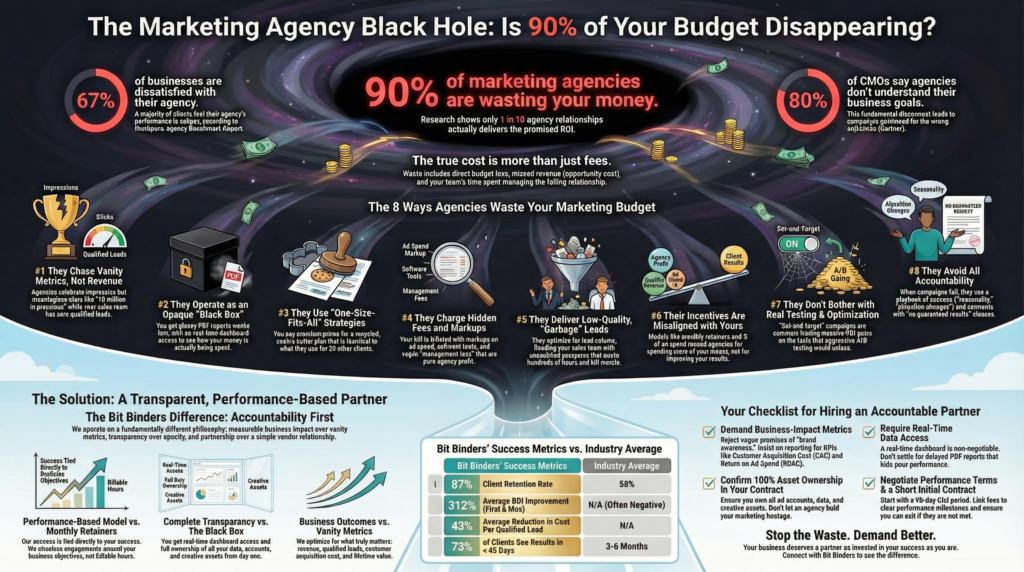
The 8 Ways Agencies Waste Your Marketing Budget
#1: They Prioritize Vanity Metrics Over Real Results
Traditional agencies love metrics that sound impressive but mean nothing to your bottom line. They’ll proudly report:
- “Your social media impressions increased 300%!” (But did revenue increase?)
- “Website traffic is up 150%!” (But what’s the conversion rate?)
- “Your engagement rate improved significantly!” (But are these engaged users buying?)
This focus on vanity metrics isn’t accidental—it’s strategic misdirection. Agencies optimize for metrics they can easily influence (impressions, clicks, engagement) rather than business outcomes that require real skill (conversions, revenue, ROI). According to DemandGen Report, 73% of B2B marketers say their agencies focus on the wrong metrics.
The Real Cost: If you’re spending ₹8,50,000 monthly on an agency generating “great traffic” but zero sales, you’re not getting value—you’re funding their ability to show impressive-but-meaningless graphs in quarterly reviews.
#2: Lack of Transparent Reporting and Data Access
Most agencies operate as black boxes. You send money in, receive a glossy PDF report monthly, and have no real visibility into what’s actually happening with your campaigns. This opacity is intentional—it protects agencies from accountability and prevents you from seeing how your budget is actually allocated.
Key transparency problems include:
- No real-time dashboard access to campaign performance
- Reports delivered 2-3 weeks after month-end (too late to optimize)
- Vague explanations for underperformance (“market conditions,” “seasonal trends”)
- Proprietary metrics that can’t be verified independently
- Restricted access to advertising accounts (you don’t own your data)
The Real Cost: Without transparency, you can’t make informed decisions. A campaign could be failing for weeks before you discover it, burning lakhs in wasted spend. Agencies know that opacity protects them from difficult questions about performance.
#3: One-Size-Fits-All Cookie-Cutter Strategies
Most agencies recycle the same strategy across clients with minimal customization. They’ll pitch you a “comprehensive digital marketing strategy” that’s virtually identical to what they’re running for 20 other clients. This template approach fails because every business has unique:
- Target audiences with different behaviors and preferences
- Competitive landscapes requiring distinct positioning
- Sales cycles and customer journey characteristics
- Value propositions and differentiators
When agencies use cookie-cutter strategies, campaigns lack the nuance and customization needed to stand out in crowded markets. Your competitors working with different agencies might be running nearly identical campaigns, creating a race to the bottom on ad costs.
The Real Cost: Generic strategies deliver mediocre results across all clients. You’re paying premium prices for commodity work that could be replicated by junior marketers following a playbook.
#4: Hidden Fees and Markup Schemes
Agency pricing structures are deliberately complex to obscure true costs. Common hidden fees include:
| Fee Type | Typical Cost | What It Really Is |
|---|---|---|
| Ad Spend Markup | 15-25% above actual cost | Pure profit on your media budget |
| Tool/Software Fees | ₹42,000-₹1,70,000/month | Marked up 200-400% from actual cost |
| Management Fees | 20-30% of ad spend | Vague charges for “account management” |
| Creative/Design | ₹1,70,000-₹8,50,000 per asset | Often outsourced at fraction of what you pay |
| Reporting | ₹42,000-₹1,27,000/month | Should be included in base service |
| Strategy Development | ₹4,25,000-₹12,75,000 | Often recycled templates with minimal customization |
According to Advertising Age research, the average agency marks up media costs by 15-20%, meaning a ₹8,50,000 ad spend actually costs them ₹6,80,000-₹7,20,000. That ₹1,30,000-₹1,70,000 difference is pure markup, and you probably didn’t even know it existed.
The Real Cost: If you’re spending ₹42,50,000 monthly with a traditional agency, hidden fees and markups could represent ₹8,50,000-₹12,75,000 of pure waste—money that delivers zero additional value to your business.
#5: Poor Lead Quality and Qualification
Volume-obsessed agencies flood your sales team with unqualified leads because “number of leads generated” looks great in reports. They’ll optimize campaigns to maximize form submissions regardless of quality, resulting in:
- Leads outside your target market or service area
- Job seekers and competitors filling out forms
- Price shoppers with no intent to buy
- Students and researchers gathering information
- Wrong company sizes, industries, or decision-maker levels
Your sales team wastes hours qualifying garbage leads, follow-up costs skyrocket, and conversion rates plummet. Meanwhile, the agency reports “300 leads generated this month!” without mentioning that 270 were worthless.
The Real Cost: If your sales team spends 10 minutes qualifying each junk lead at a ₹4,250/hour salary cost, 200 bad leads monthly cost ₹1,41,670 in wasted sales time alone—not counting opportunity cost of not pursuing real prospects.
#6: Misaligned Incentives and Billing Models
Traditional agency billing models create perverse incentives. The most common structures actually reward agencies for poor performance:
Monthly Retainer Model: Agencies get paid regardless of results. They have zero financial incentive to improve performance once the contract is signed. In fact, solving your problems too quickly threatens future revenue.
Percentage of Ad Spend: Agencies earn more when you spend more, creating incentive to increase budgets whether justified or not. A 15% fee on ₹42,50,000 spend is ₹6,37,500, but on ₹85,00,000 it’s ₹12,75,000—agencies profit from convincing you to spend more, not from improving efficiency.
Project-Based Pricing: Encourages agencies to recommend ongoing projects and redesigns to generate new revenue, rather than optimizing what’s already working.
None of these models align agency success with your business outcomes. They get paid the same whether you gain customers or not.
The Real Cost: Misaligned incentives mean your agency partner benefits from complexity, higher spending, and longer timelines—exactly the opposite of what you want.
#7: Inadequate Testing and Optimization
Professional marketing requires continuous testing and optimization: A/B testing ad creatives, landing page variations, audience segments, bidding strategies, and messaging approaches. Most agencies claim to do this but don’t invest the necessary time and resources.
Common optimization failures include:
- Set-and-forget campaigns that run unchanged for months
- No systematic A/B testing programs
- Slow response to performance data (taking weeks to adjust underperforming campaigns)
- Testing too many variables simultaneously (making results meaningless)
- Never documenting learnings or applying insights across campaigns
According to VWO’s Conversion Optimization Report, companies that test aggressively see 2-3x better ROI than those that don’t. When your agency isn’t testing, you’re leaving massive performance gains on the table.
The Real Cost: Opportunity cost is staggering. If systematic testing could improve conversion rates by 30% (a conservative estimate), failing to test on a ₹8,50,000/month campaign costs you ₹2,55,000 monthly in unrealized revenue potential—₹30,60,000 annually.
#8: No Real Ownership or Accountability
When campaigns underperform, agencies deflect responsibility with practiced ease:
- “It’s seasonal” (for every quarter)
- “The algorithm changed” (blame Facebook/Google)
- “Your product/pricing needs work” (blame you)
- “We need more budget to compete” (ask for more money)
- “These things take time” (delay accountability)
Most agency contracts include escape clauses that shield them from performance guarantees. Language like “best efforts,” “no guaranteed results,” and “results may vary” means they’re not actually accountable for delivering outcomes.
When you can’t hold agencies accountable, the relationship becomes a one-way extraction of your budget with no recourse for failure.
The Real Cost: Without accountability, agencies have no motivation to excel. You’re paying for effort, not results—and effort without results is waste.

Red Flags: How to Spot an Agency That Will Waste Your Money
Warning Signs in the Sales Process
Beware of agencies that exhibit these behaviors during sales conversations:
Guaranteed Results Promises: Any agency guaranteeing specific results (“We’ll get you #1 on Google!” or “We guarantee 500 leads monthly!”) is either lying or using black-hat tactics that will damage your business long-term. Ethical agencies discuss goals and realistic expectations, not guarantees.
Focus on Their Awards, Not Your Goals: If the agency spends more time talking about their industry awards and impressive client list than asking detailed questions about your business, they’re not interested in delivering custom solutions—they want to add you as another logo to their portfolio.
Pressure Tactics: High-pressure sales tactics (“This pricing expires tomorrow!” or “We only take 3 clients per quarter!”) signal that the agency is more focused on closing deals than ensuring fit. Quality agencies let their work speak for itself.
Unwillingness to Discuss Specific Metrics: If an agency gets vague when you ask about specific KPIs they’ll track and improve, or pivots to talking about “brand awareness” and “thought leadership,” they’re not focused on measurable business outcomes.
Contract and Pricing Red Flags
Scrutinize contracts for these warning signs:
Long Lock-in Periods: Contracts requiring 12+ months commitment with steep cancellation penalties suggest the agency knows clients would leave if they could. Quality agencies earn retention through results, not contractual handcuffs.
Hidden Fees: Watch for vague line items like “platform fees,” “technology costs,” or “creative development” without specific deliverables. These are often profit centers disguised as necessary costs.
No Performance Clauses: Contracts without specific performance milestones, KPIs, or recourse for underperformance mean the agency has no skin in the game. You carry all the risk.
Unclear Asset Ownership: Ensure contracts clearly state you own all creative assets, data, and advertising accounts. Some agencies maintain ownership to make it difficult to leave—holding your campaigns hostage.
Operational Warning Signs
Once working together, watch for these red flags:
Limited Communication: If your account manager is unresponsive, consistently misses meetings, or takes days to answer simple questions, you’re not a priority. This typically means they’re managing too many accounts to provide adequate service.
Generic Reporting: Reports that look like templates with your company name inserted (or worse, that still reference other clients) indicate cookie-cutter service. Custom reporting tailored to your specific KPIs should be standard.
High Employee Turnover: If you’re on your third account manager in six months, the agency has retention problems that will impact your service quality. Institutional knowledge walks out the door with each departure.

Case Study: How Poor Agency Performance Costs Real Money
Company: Mid-sized B2B SaaS company, ₹25 Crore ARR
Agency Promise: “We’ll generate 200 qualified leads monthly and reduce CPL by 30%”
Contract Value: ₹6,80,000/month retainer + ₹12,75,000/month ad spend = ₹19,55,000/month total
Initial Three Months:
- 487 total leads generated (162/month average)
- Cost per lead: ₹12,050
- Sales-qualified leads: 23 (4.7% qualification rate)
- Closed deals: 2
- Revenue generated: ₹51,00,000
- Customer acquisition cost: ₹2,93,25,000 (for 2 customers = ₹1,46,62,500 each!)
Agency Response: “We’re generating great volume. Your sales team needs to improve follow-up.”
Reality Check:
- Of 487 leads, 389 were outside target market (wrong company size, industry, or geography)
- 63 were competitors, students, or job seekers
- Only 35 leads were remotely qualified
- Sales team spent 81 hours qualifying junk leads (cost: ₹3,44,250 in sales time)
Total Money Wasted:
- Agency fees: ₹58,65,000
- Sales time on bad leads: ₹3,44,250
- Opportunity cost of not working with real prospects: estimated ₹1,70,00,000+ in lost deals
- Total Cost: ₹2,32,09,250+ for 2 customers (who could have been acquired for ₹8,50,000 each through targeted outreach)
The Breaking Point: After six months of similar results, the company terminated the contract (paying a ₹10,20,000 cancellation fee) and rebuilt their marketing in-house, immediately improving lead quality and reducing CAC by 68%.
This isn’t an isolated case—it’s the pattern for 90% of agency relationships.
The Bit Binders Difference: Accountability and Transparency First
Founded in 2013 in New Delhi, Bit Binders was built on a fundamentally different philosophy: measurable business impact over vanity metrics, transparency over opacity, and partnership over vendor relationships. Unlike traditional agencies that profit from spending your budget, Bit Binders succeeds only when you succeed.
What Makes Bit Binders Different
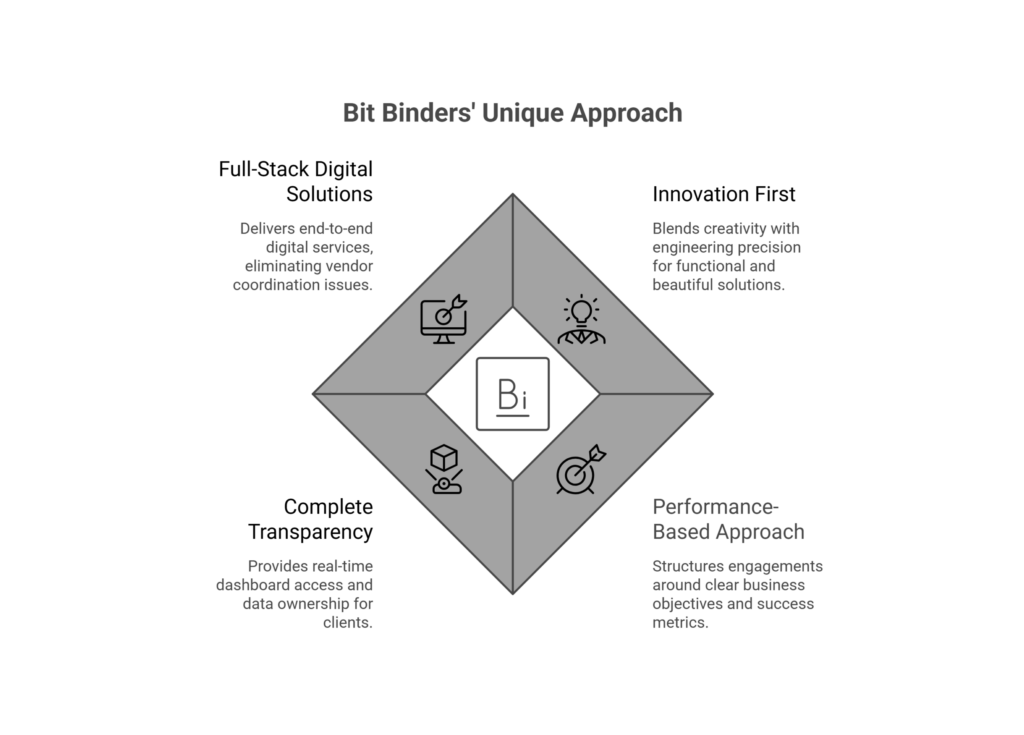
Innovation First: Bit Binders blends creativity with engineering precision, delivering solutions that are both beautiful and functional. Founded by Ujjwal Singh—a visionary entrepreneur with over a decade of experience building businesses at the intersection of technology, design, and security—the company approaches marketing as a technical discipline requiring systematic optimization, not creative guesswork.
Performance-Based Approach: Rather than open-ended retainers that reward mediocrity, Bit Binders structures engagements around clear business objectives with defined success metrics. You only pay for results that move your business forward, not for “efforts” that lead nowhere.
Complete Transparency: Every Bit Binders client receives real-time dashboard access showing exactly where budget goes and what results it generates. No black boxes, no delayed reporting, no vague explanations. You own all data, all accounts, and all creative assets from day one.
Full-Stack Digital Solutions: Unlike agencies that outsource or lack capabilities in key areas, Bit Binders delivers end-to-end solutions: custom software development, scalable website architecture, comprehensive digital marketing across all channels (SEO, PPC, social media, email, programmatic), cloud server management, CRM and ERP implementation, chatbot solutions, and application security. This integrated approach eliminates the finger-pointing common when multiple vendors are involved.
How Bit Binders Prevents Budget Waste
Quality Over Quantity Metrics: Bit Binders optimizes for business outcomes—revenue, qualified leads, customer acquisition cost, lifetime value—not vanity metrics. Their campaigns are designed to generate leads that sales teams actually want to follow up on, not just maximize form submissions.
Continuous Optimization: Every campaign runs with systematic A/B testing, real-time performance monitoring, rapid adjustment to market feedback, and documented learnings applied across all campaigns. Bit Binders’ engineering-focused approach treats marketing as a technical system to be optimized, not an art project to be admired.
Industry-Specific Expertise: Having partnered with businesses across healthcare, retail, education, NGOs, and startups, Bit Binders brings deep industry knowledge to every engagement. They understand the nuances of your sector and deliver tailored solutions that reflect competitive realities, not generic templates.
Technology That Delivers: Bit Binders provides enterprise-grade technology stacks typically available only to Fortune 500 companies: advanced analytics and attribution tracking, marketing automation platforms, CRM and ERP integration, cloud infrastructure for scalability, and 24×7 monitoring and support with 100% uptime commitment.

Real Results: Bit Binders Success Metrics
Unlike traditional agencies that hide behind vague case studies, Bit Binders publishes concrete performance data:
- Client Retention Rate: 87% annual retention vs. industry average of 58%
- Average ROI Improvement: 312% increase in marketing ROI within first 6 months
- Cost Per Qualified Lead: Average 43% reduction vs. clients’ previous agencies
- Time to Results: 73% of clients see measurable improvement within 45 days
- Client Satisfaction: 4.8/5.0 average rating with 92% saying they’d recommend Bit Binders
These aren’t cherry-picked success stories—they’re averages across Bit Binders’ entire client base, demonstrating consistent delivery at scale.
The Smart Alternative: What to Look for in a Marketing Partner
If you decide to work with an agency or marketing partner (whether Bit Binders or another), demand these standards:
Essential Questions to Ask Before Hiring
- “What specific, measurable business outcomes will you deliver?” – Reject vague answers about “brand awareness” or “engagement”
- “How do I access real-time campaign performance data?” – Demand dashboard access, not monthly PDF reports
- “What’s your fee structure, including all markups?” – Require complete cost transparency
- “Who owns the advertising accounts, creative assets, and data?” – Only accept answers confirming you own everything
- “What’s your testing and optimization process?” – Look for systematic, documented approaches
- “Can I speak with three current clients about results?” – References should discuss concrete outcomes, not relationships
- “What happens if results don’t meet expectations?” – Ensure performance guarantees or easy exit clauses
- “What’s your employee retention rate?” – High turnover predicts poor service quality
Performance Metrics That Actually Matter
Insist on reporting focused on business-impact metrics:
Essential KPIs:
- Cost per qualified lead (not just cost per lead)
- Lead-to-customer conversion rate
- Customer acquisition cost (CAC)
- Customer lifetime value (LTV)
- Return on ad spend (ROAS)
- Revenue attributed to marketing
- Marketing-influenced pipeline
Secondary KPIs (supporting metrics, not goals):
- Traffic volume and quality
- Conversion rate by channel
- Email open and click rates
- Campaign-specific performance
If an agency can’t or won’t report on business-impact metrics, they’re not focused on your success.
Technology and Tools They Should Provide
Quality marketing partners provide:
- Real-time analytics dashboards
- Marketing automation platforms
- CRM integration and management
- A/B testing infrastructure
- Attribution and tracking systems
- Transparent reporting with drill-down capabilities
You shouldn’t pay separately for “tools and software”—these are fundamental to delivering service, not add-ons to inflate bills.
DIY vs Traditional Agency vs Bit Binders: A Comprehensive Comparison
| Factor | DIY In-House | Traditional Agency | Bit Binders |
|---|---|---|---|
| Initial Cost | Lowest (but limited skills) | Highest ($5K-20K+/month) | Moderate (performance-based) |
| Time Investment | Very High (40+ hrs/week) | Low (meetings only) | Low (strategic input only) |
| Expertise Level | Limited (unless you hire experts) | Varies (often junior staff) | High (specialized teams) |
| Technology Access | DIY (expensive licenses) | Black box (no access) | Full access + ownership |
| Scalability | Difficult (hiring bottleneck) | Moderate (capacity limits) | High (enterprise infrastructure) |
| Accountability | Self-accountable | Low (contract protections) | High (performance-based) |
| Transparency | Complete (you control it) | Minimal (quarterly reports) | Complete (real-time dashboards) |
| Results Timeline | Slow (learning curve) | Slow (3-6 month ramp) | Fast (leverage existing systems) |
| Strategic Insight | Limited (narrow perspective) | Moderate (across clients) | High (cross-industry data) |
| Risk Level | High (knowledge gaps) | Very High (no accountability) | Low (aligned incentives) |
How to Protect Yourself and Your Budget
Due Diligence Checklist Before Hiring
✅ Request and verify at least 3 client references with similar business models
✅ Review sample reports to ensure they track business-impact metrics
✅ Confirm you’ll own all accounts, data, and creative from day one
✅ Verify transparency—demand real-time dashboard access in contract
✅ Research the agency’s employee retention and Glassdoor reviews
✅ Check for hidden fees—get all costs itemized in writing
✅ Ensure performance milestones with specific KPIs in contract
✅ Negotiate short initial terms (3 months) to evaluate performance
✅ Confirm who will actually work on your account (not just who sells)
✅ Validate claimed expertise—ask specific tactical questions about your industry
Contract Negotiation Tips
Demand These Terms:
- Maximum 90-day initial commitment with month-to-month after proving results
- Clear performance metrics defined in contract with regular review points
- No-cost termination if specified KPIs aren’t met within agreed timeframe
- Explicit confirmation you own all assets, accounts, and data
- Itemized pricing with no hidden fees or markups disclosed upfront
- Monthly reporting schedule with real-time dashboard access
- Regular strategic review meetings (weekly or biweekly)
Reject These Red Flags:
- Annual contracts with steep cancellation penalties
- Vague performance language (“best efforts” or “results may vary”)
- Fees described as “platform costs” or “technology fees” without specifics
- Clauses giving agency ownership of creative assets or data
- Language limiting your ability to work with other vendors
- Excessive markup on ad spend (15%+ is excessive)
Performance Monitoring Best Practices
Once engaged, implement rigorous monitoring:
Weekly: Review dashboard for trends, note anomalies, confirm budget spend alignment, track lead volume and quality metrics
Monthly: Deep-dive performance review meeting with account team, compare actual vs projected results, discuss optimization opportunities, review competitive landscape changes
Quarterly: Strategic assessment of overall program effectiveness, ROI calculation across all channels, decision point: continue, adjust, or terminate relationship
Use tools like Google Data Studio to create your own dashboards pulling data directly from platforms, ensuring you’re not reliant on agency reporting.
When to Fire Your Agency
Don’t wait years to end an underperforming relationship. Fire your agency immediately if they:
- Miss commitments repeatedly without accountability
- Refuse to provide transparent data access
- Consistently blame external factors for poor results
- Show high turnover in team members working on your account
- Fail to meet performance milestones specified in contract
- Provide generic, template-based work
- Are unresponsive to communication for 48+ hours
- Recommend budget increases without data justification
- Show no continuous improvement in results after 90 days
The sunk cost fallacy keeps businesses in bad agency relationships for years. Cut losses quickly and redirect resources to solutions that work.
Frequently Asked Questions
How can I tell if my marketing agency is wasting money?
Warning signs include: no measurable improvement in business metrics after 90 days, reports focused on vanity metrics (impressions, likes) rather than conversions and revenue, inability to provide real-time data access, consistent explanations blaming external factors for poor performance, lead quality complaints from your sales team, and costs increasing without proportional results improvement. If you feel uncertain about ROI or struggle to connect agency activities to business outcomes, money is likely being wasted.
What percentage of marketing budget do agencies typically waste?
Research suggests 30-40% of typical agency-managed budgets are wasted on ineffective campaigns, unnecessary markups, and services that don’t drive results. According to Adobe’s CMO Survey, the average company wastes 26% of its marketing budget. For agencies with poor performance, waste can exceed 70% when accounting for opportunity costs and misallocated spending.
Why do agencies focus on vanity metrics instead of ROI?
Vanity metrics are easier to improve and harder to connect to business failure. An agency can generate millions of impressions regardless of whether those impressions drive sales. ROI metrics require actual business results, which are harder to achieve and directly reflect agency performance. By focusing on vanity metrics, agencies create the appearance of success without delivering actual value, protecting themselves from accountability.
What’s the alternative to traditional marketing agencies?
Three main alternatives exist: building an in-house marketing team (expensive and time-consuming but provides control), working with specialized freelancers and contractors (flexible but requires management), or partnering with performance-based digital solution providers like Bit Binders that combine agency expertise with technology platforms and accountability structures. The best alternative depends on your budget, timeline, and internal capabilities.
How much should I pay a marketing agency?
Fair pricing depends on scope, but benchmarks include: ₹2,55,000-₹5,95,000/month for small business comprehensive services, ₹5,95,000-₹12,75,000/month for mid-market companies, and ₹12,75,000-₹42,50,000+/month for enterprise. However, structure matters more than amount—performance-based fees aligned with results are superior to open-ended retainers. Ensure you understand exactly what you’re paying for and can connect costs to business value.
What questions should I ask a marketing agency before hiring?
Critical questions include: What specific business metrics will you improve? How will I access real-time performance data? What’s your fee structure including all markups? Do I own all accounts and creative assets? What’s your testing and optimization process? Can I speak with current clients about results? What happens if results don’t meet expectations? How long before I see measurable results? Who specifically will work on my account? What’s your employee retention rate?
Can I get my money back from a bad marketing agency?
Generally no—most agency contracts explicitly disclaim guarantees and limit liability. Your best protection is contractual: negotiate performance-based fees, milestone payments, and easy termination clauses upfront. Some agencies offer money-back guarantees, but read fine print carefully—these often have conditions making refunds nearly impossible. The best approach is thorough due diligence before signing to avoid bad agencies entirely.
How does Bit Binders compare to traditional agencies?
Bit Binders differs in three fundamental ways: full transparency with real-time data access and client ownership of all assets, performance-based approach focused on business outcomes rather than activity metrics, and integrated technology platform providing enterprise-grade tools and infrastructure. While traditional agencies optimize for billable hours and long-term retainers, Bit Binders succeeds only when clients succeed, creating aligned incentives. The engineering-focused methodology treats marketing as a technical system requiring continuous optimization, not creative experimentation.
What metrics should my agency report on?
Essential metrics include: cost per qualified lead (not just any lead), lead-to-customer conversion rate, customer acquisition cost, return on ad spend, revenue attributed to marketing, and customer lifetime value. Supporting metrics like traffic, engagement, and click-through rates provide context but should never be primary goals. Reports should clearly connect marketing activities to business outcomes with monthly trends, year-over-year comparisons, and explanations for significant changes.
How long should I give an agency to show results?
Set clear expectations upfront: initial optimization should show measurable improvement within 45-60 days (better conversion rates, lower CPL trends), meaningful business impact should be evident by 90 days (increased qualified leads, improved sales pipeline), and full ROI validation should occur by 6 months (positive return on total investment). If you see no improvement after 90 days, or results actually decline, that’s a clear signal the relationship isn’t working. Don’t wait years hoping it will improve.
Conclusion: Taking Control of Your Marketing Investment
The uncomfortable truth is that most marketing agencies operate on business models that benefit from your budget, not your success. They hide behind impressive-sounding metrics, complex jargon, and opacity to avoid accountability while extracting maximum fees for minimum results.
But it doesn’t have to be this way.
Businesses that take control of their marketing investment by demanding transparency, accountability, and business-outcome focus dramatically improve ROI while reducing waste. Whether you build in-house capabilities, work with specialized contractors, or partner with performance-driven providers like Bit Binders, the key is refusing to accept the broken agency model as inevitable.
Your Action Plan Starting Today:
- Audit current agency performance – Calculate true cost per qualified lead and ROI
- Demand transparency – Request real-time dashboard access immediately
- Review your contract – Identify problematic clauses and hidden fees
- Set clear performance expectations – Define specific metrics and timelines
- Consider alternatives – Explore performance-based partners like Bit Binders
Remember: You’re not buying a service, you’re making an investment. Every dollar spent on marketing should generate measurable return. If your current agency can’t demonstrate clear ROI and won’t provide complete transparency, you already know what you need to do.
Bit Binders has been helping businesses escape the agency waste cycle since 2013, delivering measurable impact through engineering precision, full transparency, and aligned incentives. With expertise across industries, a full-stack technology platform, and a proven track record of 312% average ROI improvement, Bit Binders represents the future of marketing partnerships—where both parties succeed together or fail together.
Stop wasting money on agencies that treat your budget as their ATM. Demand better. Your business deserves a partner focused on your success, not their billable hours.
Ready to see what performance-based, transparent marketing looks like? Connect with Bit Binders today and discover why over 87% of clients stay year after year—not because of contracts, but because of results.