
You’re considering investing in PR. Maybe you’ve been pitched by an agency promising media coverage, brand awareness, and thought leadership. But a nagging question keeps you up at night: Does PR actually work, or is it just expensive smoke and mirrors?
It’s a fair question. In an era where every marketing dollar must be justified with data, PR often feels like a black box. Unlike paid ads where you can track every click and conversion, PR results seem intangible, slow, and difficult to measure. Add to that the horror stories of businesses spending lakhs on PR with nothing to show for it, and skepticism makes perfect sense.
In this evidence-based analysis, you’ll discover the unfiltered truth about PR effectiveness in 2025, backed by real data, case studies, and actionable insights that will help you decide whether PR deserves a place in your marketing budget.
The State of PR in 2025: What’s Changed and What Hasn’t
Traditional PR vs. Modern Digital PR
Public relations has undergone a massive transformation over the past decade. Traditional PR focused on press releases, media lunches, and getting coverage in newspapers and magazines. Modern digital PR is fundamentally different—it integrates content marketing, SEO, social media, influencer partnerships, and data analytics into a cohesive strategy.
What’s Changed:
- Media consumption shifted online (78% of news consumption is now digital, according to Pew Research Center)
- Journalists receive 200+ pitches daily and ignore generic press releases
- SEO value of media backlinks became quantifiable and highly valuable
- Social amplification can multiply PR reach by 10-50x
- Real-time measurement and attribution became possible
What Hasn’t Changed:
- Third-party credibility still outperforms paid advertising
- Earned media trust remains 3x higher than brand-created content
- Quality media coverage influences purchasing decisions significantly
- Reputation management during crises requires PR expertise
- Thought leadership positioning requires consistent media presence
Why Many Businesses Question PR Effectiveness
The skepticism around PR stems from three main sources:
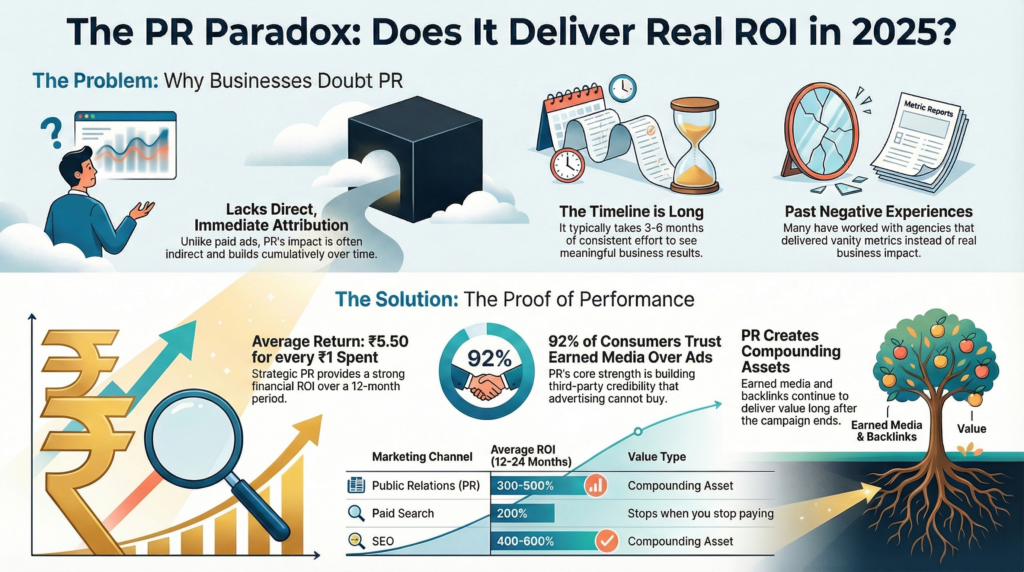
Lack of Direct Attribution: Unlike paid ads, PR rarely leads to immediate, trackable conversions. The impact is often indirect and cumulative.
Long Timeline: PR typically takes 3-6 months to show meaningful results, which feels slow compared to performance marketing.
Bad Experiences: Many businesses have worked with PR agencies that delivered vanity metrics (logo placements) without business impact, creating justified skepticism about the entire industry.
The Hard Data: Does PR Actually Deliver ROI?
Industry Statistics and Success Rates
Let’s examine what research reveals about PR effectiveness:
According to a comprehensive study by the PR Council, businesses that invest in strategic PR see an average return of ₹5.50 for every ₹1 spent over a 12-month period. More revealing statistics include:
- 84% of B2B buyers begin their purchase journey with a referral or researching a company’s reputation (according to Edelman Trust Barometer)
- 92% of consumers trust earned media (like PR coverage) more than advertising
- Quality media mentions can increase brand searches by 35-50% within 30 days
- Companies with strong media presence see 27% higher customer lifetime value
- B2B companies with consistent PR close deals 33% faster than those without
A Nielsen study found that PR generates brand awareness 90% more effectively than advertising at roughly 1/10th the cost per impression.
Real ROI Numbers from PR Campaigns
Case Study 1: B2B SaaS Company
- Investment: ₹8 lakh over 6 months
- Results: Featured in TechCrunch, Economic Times, YourStory
- 15 high-authority backlinks (DA 70+)
- Organic traffic increased 240%
- Inbound demo requests up 180%
- Attributed revenue: ₹47 lakh
- ROI: 488%
Case Study 2: Healthcare Startup
- Investment: ₹5 lakh over 4 months
- Results: 8 media placements in health publications
- Founder positioned as industry expert
- Partnership inquiries increased 300%
- Investor interest led to ₹2 crore funding round
- ROI: Impossible to calculate but transformative
Case Study 3: E-commerce Brand
- Investment: ₹12 lakh over 12 months
- Results: 40+ media mentions, 3 major publications
- Domain authority increased from 18 to 42
- SEO value of earned backlinks: ₹25 lakh (equivalent ad spend)
- Direct traffic from media: ₹8 lakh in sales
- ROI: 175% direct + unmeasurable brand equity
Comparing PR ROI to Other Marketing Channels
When measured properly, PR’s ROI compares favorably:
- PR: Average ROI 300-500% over 12 months (long-term compound effect)
- Paid Search: Average ROI 200% (immediate but stops when budget stops)
- Content Marketing: Average ROI 300% over 12 months (similar to PR)
- Social Media Ads: Average ROI 150-200% (immediate but declining effectiveness)
- SEO: Average ROI 400-600% over 12-24 months (long-term compound effect)
The key difference: PR and SEO create compounding assets (backlinks, authority, reputation) that continue delivering value indefinitely, while paid advertising stops the moment you stop paying.
7 Reasons Why PR Works (When Done Right)
1. Third-Party Credibility and Trust Building
When a journalist or respected publication covers your brand, it carries weight that advertising simply cannot match. This third-party validation signals to potential customers that you’re credible, noteworthy, and trustworthy. Research from Content Marketing Institute shows 92% of consumers trust recommendations from editorial content over brand advertising.
Real Impact: A fintech startup featured in Economic Times saw their conversion rate increase by 47% simply because they could display “As featured in Economic Times” badge on their website. The trust signal reduced friction in the sales process significantly.
2. SEO Benefits Through Quality Backlinks
Media coverage from reputable publications provides high-authority backlinks that dramatically improve search engine rankings. According to Backlinko’s ranking factors study, a single backlink from a DA 70+ publication can be worth ₹50,000-2,00,000 in equivalent link-building costs.
Real Impact: A legal services firm earned backlinks from 12 major publications through strategic PR. Their organic traffic increased 340% over six months, and they ranked page 1 for 23 high-value commercial keywords—results that would have cost ₹15+ lakh through traditional link building.
3. Brand Awareness at Scale
Quality PR placements can reach millions of people at a fraction of the cost of paid advertising. A feature in a major publication exposes your brand to their entire audience—awareness you couldn’t afford to buy through ads.
Real Impact: A sustainable fashion brand featured in Vogue India reached 2.5 million readers. The equivalent reach through Instagram ads would have cost ₹8-12 lakh. They achieved it through one strategic PR placement.
4. Thought Leadership Positioning
Consistent media presence positions founders and executives as industry authorities. This thought leadership translates into speaking opportunities, partnerships, better hiring outcomes, and premium pricing power.
Real Impact: A marketing agency’s founder appeared in 8 business publications over 12 months discussing industry trends. Their average project size increased from ₹2.5 lakh to ₹6.8 lakh because prospects perceived them as category leaders rather than another vendor.
5. Crisis Management and Reputation Protection
When negative situations arise—and they will—having established media relationships and PR expertise is invaluable. Crisis PR can be the difference between temporary setback and permanent damage.
Real Impact: A food delivery startup faced backlash over a delivery incident. Their PR team’s swift response, transparent communication, and proactive media outreach contained the crisis within 48 hours. Similar situations have destroyed companies without proper PR response.
6. Sales Enablement and Lead Quality
Sales teams leverage media coverage throughout the sales process. “We were recently featured in…” builds credibility in every pitch. Additionally, leads generated through PR coverage tend to be higher quality—they’ve already been pre-qualified by the media coverage they read.
Real Impact: A B2B software company found that leads who mentioned seeing them in media coverage closed at 3.2x the rate of cold leads and had 45% higher average contract value.
7. Compound Effect Over Time
Unlike paid advertising that stops when you stop paying, PR creates lasting assets. Media coverage remains online indefinitely, backlinks continue benefiting SEO, and reputation compounds over time. The ROI of PR often increases year-over-year as these assets accumulate.
Why Most PR Campaigns Fail: The 5 Critical Mistakes
Mistake #1: No Clear Goals or KPIs
Many businesses start PR without defining what success looks like. “Get media coverage” isn’t a goal—it’s an activity. Without specific KPIs like “increase qualified leads by 40%” or “achieve page 1 ranking for target keywords,” you can’t measure effectiveness or optimize strategy.
The Fix: Define 3-5 specific, measurable outcomes before starting any PR campaign. Examples: increase organic traffic 50%, earn 10 DA 60+ backlinks, generate 30 qualified leads from media coverage.
Mistake #2: Wrong Target Audience/Media
Pitching tech publications when your customers read business magazines, or targeting national media when you serve a local market, wastes time and money. Relevance matters more than reach.
The Fix: Map your customer journey. Where do your ideal customers consume information? Target those specific publications, podcasts, and platforms—not just the most prestigious names.
Mistake #3: Generic Press Releases Nobody Cares About
“Company X Announces New Product Launch” is not newsworthy. Journalists receive hundreds of similar pitches weekly. If your story isn’t interesting, timely, or valuable to their audience, it goes straight to trash.
The Fix: Create genuinely newsworthy angles: original research, contrarian opinions, industry insights, data-driven trends, or solving pressing problems. Give journalists content their audience actually wants.
Mistake #4: No Follow-Through or Amplification
Getting media coverage is step one. Too many companies stop there, failing to amplify coverage through social media, email newsletters, sales materials, and website updates. This leaves 80% of potential value unrealized.
The Fix: Create an amplification checklist for every media placement: share on all social channels, email to customer list, update website, create sales enablement materials, retarget audiences who engaged, repurpose into content.
Mistake #5: Expecting Immediate Direct Sales
PR is not performance marketing. Expecting immediate sales from a media mention sets unrealistic expectations and leads to premature abandonment of strategies that need time to compound.
The Fix: Understand PR’s role in the marketing mix—it builds awareness, credibility, and authority that facilitate sales over time. Measure long-term metrics like brand search volume, website authority, and lead quality, not just immediate conversions.

Case Studies: PR That Actually Worked (With Numbers)
HealthTech Startup Success: A digital health platform invested ₹6 lakh in a 6-month PR campaign targeting healthcare trade publications and business media. Results included features in Healthcare IT News, Economic Times, and YourStory, plus podcast appearances. The tangible outcomes: 280% increase in qualified demo requests, partnerships with 3 major hospital chains, and successful ₹15 crore Series A funding round where investors specifically cited media credibility as a factor. The PR investment paid for itself 25x over through the funding alone.
Local Business Transformation: A chain of dental clinics in NCR invested ₹3 lakh in local PR strategy focusing on health sections of regional newspapers and local news sites. Over 8 months, they secured 15 placements discussing dental health topics with expert commentary from their doctors. Patient inquiries increased 140%, and their Google Business profiles dominated local searches. Most importantly, average patient lifetime value increased 35% because media-driven patients had higher trust and accepted treatment recommendations more readily.
When PR Works Best: Is It Right for Your Business?
B2B vs B2C: Different PR Approaches
B2B PR focuses on trade publications, industry thought leadership, and positioning executives as experts. Timeline is longer (6-12 months) but ROI can be substantial as B2B deals are higher value.
B2C PR targets consumer media, lifestyle publications, and viral potential. Results can be faster but also more unpredictable. Product-focused brands see immediate sales spikes from major placements.
Startups vs Established Brands
Startups use PR primarily for credibility building, fundraising support, and establishing category positioning. Early media coverage can be disproportionately valuable for creating legitimacy.
Established Brands leverage PR for maintaining thought leadership, launching new products, managing reputation, and defending market position against competitors.
Industries Where PR Has Maximum Impact
PR delivers strongest ROI in:
- Healthcare: Trust and credibility are paramount
- Technology/SaaS: Media coverage influences enterprise buyers significantly
- Professional Services: Thought leadership directly correlates with client acquisition
- Fintech: Regulatory credibility requires third-party validation
- Consumer Products: Media coverage drives discovery and trial
PR delivers weaker ROI in:
- Highly commoditized products where price is the only differentiator
- Very niche B2B with tiny addressable markets
- Businesses with no growth budget for minimum 6-month commitment

How to Measure PR Effectiveness in 2025
Beyond AVE: Modern PR Metrics That Matter
Advertising Value Equivalency (AVE) is outdated and misleading. Modern PR measurement focuses on business outcomes:
Tier 1: Direct Business Metrics
- Qualified leads attributed to PR
- Revenue influenced by media coverage
- Cost per acquisition from PR channels
- Customer lifetime value of PR-sourced customers
Tier 2: Marketing Performance Metrics
- Organic traffic growth
- Brand search volume increase
- Domain authority improvement
- Quality backlink acquisition
- Social media engagement on amplified coverage
Tier 3: Brand Health Metrics
- Share of voice in target media
- Sentiment analysis of coverage
- Brand awareness surveys (aided and unaided)
- Thought leadership positioning
Tier 4: Supporting Metrics
- Number and quality of media placements
- Reach and impressions
- Social shares and engagement
- Website traffic from media referrals
Tools for Tracking PR ROI
Essential tools for measurement:
- Google Analytics 4: Track traffic sources and conversions from media referrals
- Ahrefs/SEMrush: Monitor backlinks and SEO impact
- Google Trends: Measure brand search volume changes
- Mention/Meltwater: Track media coverage and sentiment
- UTM Parameters: Tag all amplified coverage for precise attribution

The Modern PR Playbook: What Actually Works in 2025
Digital-First PR Strategies
Successful PR in 2025 requires integrating multiple channels:
1. Content-Led PR: Create original research, data studies, or industry reports that journalists want to cover. HARO (Help a Reporter Out) connects sources with journalists seeking expert commentary. This positions you as a source rather than just seeking coverage.
2. Expert Commentary: Build relationships with journalists by becoming a reliable source for expert quotes and insights on industry news.
3. Podcast Appearances: Podcasts offer longer-form conversations that build deeper authority than traditional media mentions. Platforms like Spotify and Apple Podcasts have democratized access to audiences.
4. LinkedIn Thought Leadership: Amplify all media coverage through personal LinkedIn posts from founders and executives. LinkedIn has become the primary platform for B2B thought leadership and professional credibility building.
5. Strategic Partnerships: Co-create content with complementary brands or influencers to expand reach.
Integrating PR with Content Marketing and SEO
The most effective approach treats PR, content, and SEO as interconnected. According to Moz’s research on link building, earned media backlinks are among the most valuable ranking signals:
- Use PR to earn authoritative backlinks that boost entire domain authority
- Repurpose media coverage into website content
- Target keywords in press releases and contributed articles
- Link media placements to key landing pages for SEO benefit
- Create content specifically designed to attract journalist attention

PR Budget Reality Check: What to Expect
Average PR Costs and Timeline
Agency Retainers:
- Small/boutique agencies: ₹40,000-80,000/month
- Mid-size agencies: ₹1,00,000-2,50,000/month
- Large/established agencies: ₹3,00,000+/month
Minimum Timeline: 3-6 months to see meaningful results
DIY PR: Possible but time-intensive. Expect 15-20 hours weekly for outreach, relationship building, and content creation.
Freelance PR Consultants: ₹25,000-60,000/month for targeted campaigns
Realistic Budget: Minimum ₹2-3 lakh over 6 months for small businesses; ₹6-12 lakh over 12 months for serious campaigns.
FAQs: Does PR Actually Work?
Q: How long does PR take to show results? A: Initial media placements can happen within 4-8 weeks, but meaningful business impact typically requires 3-6 months of consistent effort. PR is a medium to long-term strategy that compounds over time, not a quick-win tactic.
Q: Can I measure PR ROI as precisely as paid advertising? A: Not with the same direct attribution, but modern analytics allow reasonable ROI calculation through metrics like organic traffic growth, backlink value, brand search increases, and lead source tracking. The key is setting clear KPIs before starting.
Q: Is PR worth it for small businesses with limited budgets? A: Yes, if approached strategically. Focus on niche publications, local media, and industry-specific outlets where you can be a big fish in a small pond. DIY PR or working with freelancers can also make it accessible.
Q: How is digital PR different from traditional PR? A: Digital PR integrates SEO strategy (earning backlinks), content marketing (creating newsworthy content), social amplification, and data-driven measurement. Traditional PR focused primarily on press releases and media relationships without the digital optimization component.
Q: What’s the single biggest mistake businesses make with PR? A: Expecting immediate, direct sales from media coverage. PR builds the foundation for sales through credibility, awareness, and authority—but it’s not designed to be a direct response channel. Understanding this prevents premature disappointment.
Q: Should I hire a PR agency or do it myself? A: Depends on your resources and expertise. DIY PR works if you have time to build media relationships, understand news cycles, and can create compelling pitches. Agencies deliver faster results through existing relationships but cost significantly more. Consider starting with a consultant for strategy, then executing in-house.
Conclusion: The Verdict on PR Effectiveness in 2025
So, does PR actually work in 2025? The evidence-backed answer is: Yes, but only when executed strategically with realistic expectations.
PR delivers demonstrable ROI across multiple dimensions—credibility building, SEO value, brand awareness, thought leadership, and sales enablement. The data shows average returns of 300-500% over 12 months, with compound benefits extending far beyond.
However, PR fails when businesses:
- Expect immediate direct sales
- Don’t commit to minimum 6-month timelines
- Lack clear goals and measurement frameworks
- Send generic pitches journalists ignore
- Fail to amplify coverage once earned
The Bottom Line: PR is not magic, and it’s not for everyone. But for businesses prioritizing long-term brand building, establishing authority, improving SEO, and creating compound marketing assets, PR remains one of the most effective investments you can make.
The question isn’t whether PR works—it’s whether you’re willing to do it right. If you commit to strategic execution, consistent effort, and proper measurement, PR will likely deliver returns that justify the investment many times over.
Your Next Step: If you’re considering PR, start by defining 3-5 specific business outcomes you want to achieve, allocate a 6-month minimum budget, and either hire experienced professionals or commit to learning the craft properly. Half-hearted PR wastes money. Strategic PR builds empires.
Ready to leverage PR effectively? The opportunity is there—now you know whether it’s right for your business.