
You’ve been quoted ₹15 lakh for a three-month media buying campaign. Or maybe you’re looking at ₹50,000 CPM rates for premium inventory. The numbers feel astronomical, and you’re wondering: what exactly am I paying for, and why does media buying cost so much?
Media buying is one of the most significant marketing investments businesses make, yet it remains one of the most misunderstood. Many business owners see the price tags without understanding the complexity, technology, expertise, and market dynamics driving those costs. The result? Either avoiding media buying entirely (leaving money on the table) or overpaying for mediocre results.
In this comprehensive guide, you’ll discover exactly what media buying is, the real factors making it expensive, transparent pricing for different channels, and strategic ways to maximize ROI while minimizing waste. Whether you’re considering your first media buy or trying to optimize existing campaigns, you’ll walk away with clarity on what you’re actually paying for.

What is Media Buying? The Fundamentals Explained
Media buying is the process of purchasing advertising space across various media channels—television, radio, digital platforms, print publications, outdoor billboards, and more—to reach your target audience with promotional messages. According to Investopedia’s marketing definition, it’s distinct from media planning, which determines where and when to advertise.
At its core, media buying involves:
- Negotiating rates with media owners or platforms
- Purchasing ad inventory (space or time slots)
- Optimizing placements for maximum reach and frequency
- Tracking performance and adjusting campaigns
- Managing budgets across multiple channels
Think of media buying as the execution phase of advertising strategy. While media planning answers “where should we advertise?”, media buying answers “how do we get the best placements at the best rates?”
Media Buying vs. Media Planning: Understanding the Difference
Many confuse these two critical functions, but they’re distinct:
Media Planning:
- Strategic research and audience analysis
- Channel selection and budget allocation
- Campaign timing and flight schedules
- Competitive analysis
- Forecasting reach and frequency
Media Buying:
- Negotiating with media vendors
- Purchasing inventory at optimal rates
- Placement optimization
- Performance monitoring
- Budget management and reconciliation
Smart campaigns require both. Planning sets the strategy; buying executes it efficiently.
The Media Buying Process: How It Actually Works
The typical media buying process follows these stages:
1. Request for Proposals (RFPs): Media buyers contact publishers, networks, or platforms requesting rate cards and available inventory.
2. Negotiation: Buyers negotiate pricing, placement, added value, and terms. Experienced buyers leverage relationships and market knowledge for better deals.
3. Insertion Orders: Legal agreements specifying exactly what’s being purchased, when it runs, and at what cost.
4. Campaign Launch: Ads go live according to agreed schedules.
5. Monitoring and Optimization: Continuous tracking of performance with adjustments to maximize ROI.
6. Reconciliation: Verifying ads ran as promised and negotiating make-goods for underdelivery.

Types of Media Buying (Traditional vs. Digital)
Traditional Media Buying:
- Television and radio spots
- Print advertisements (newspapers, magazines)
- Outdoor advertising (billboards, transit)
- Direct negotiation with media companies
- Manual insertion orders and trafficking
Digital Media Buying:
- Display advertising (banner ads, rich media)
- Video advertising (YouTube, streaming platforms)
- Social media advertising (Facebook, Instagram, LinkedIn)
- Search advertising (Google Ads, Bing)
- Programmatic buying (automated, real-time bidding)
- Native advertising
According to eMarketer’s digital advertising forecast, digital media buying now represents over 60% of total advertising spending globally, driven by superior targeting capabilities and measurement precision.
Why Media Buying is Expensive: The 8 Cost Factors
1. Premium Inventory and High Demand
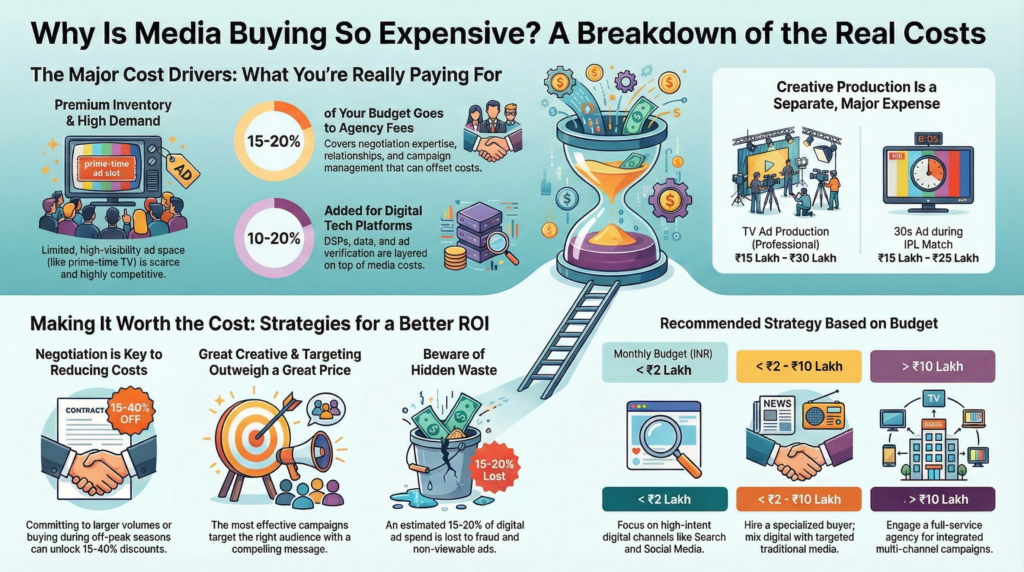
The fundamental economic principle of supply and demand drives media costs. Premium inventory—prime-time TV slots, homepage takeovers on major websites, billboards in high-traffic areas—is limited and highly sought after.
Real Example: A 30-second spot during Indian Premier League (IPL) cricket matches costs ₹15-25 lakh per spot due to massive viewership. Popular Hindi GECs (General Entertainment Channels) during prime time (8-11 PM) charge ₹2-4 lakh per 10-second spot. These premium slots deliver guaranteed mass reach, justifying premium pricing.
Digital Premium Inventory: Google Display Network placements on The Times of India or Economic Times websites cost 3-5x more than remnant inventory on smaller sites because of audience quality and brand safety.
2. Agency Fees and Markups
Media buying agencies don’t work for free. Their fees cover expertise, relationships, negotiation leverage, and campaign management. Understanding fee structures prevents surprises:
Commission Model: Traditional 15-20% markup on media spend. For a ₹10 lakh media buy, agency keeps ₹1.5-2 lakh.
Fee-Based Model: Flat monthly retainer (₹50,000-3,00,000+) regardless of media spend.
Hybrid Model: Lower commission (5-10%) plus management fee.
Why Agencies Cost This Much:
- Years of relationship building with media vendors
- Negotiation expertise saving 20-30% off rate cards
- Campaign optimization improving performance
- Administrative burden of insertion orders, trafficking, reconciliation
- Market intelligence and strategic guidance
According to the Association of National Advertisers, experienced media buyers typically negotiate savings that more than offset their fees, making them cost-neutral or profit-positive.
3. Platform Costs and Technology Fees
Digital media buying involves sophisticated technology platforms charging significant fees:
Demand-Side Platforms (DSPs): Tools like Google DV360, The Trade Desk, or Adobe Advertising Cloud charge 10-20% tech fees on top of media costs.
Data Management Platforms (DMPs): Audience data providers charge for access to targeting segments.
Verification and Measurement: Tools ensuring ads were seen by humans (viewability) and reached intended audiences add 2-5% to costs.
Creative Serving Fees: Platforms hosting and delivering ad creative charge CPM-based fees.
For a ₹10 lakh digital campaign, technology fees alone can add ₹1.5-3 lakh to the total cost.
4. Production and Creative Costs
Media buying costs don’t include creating the ads themselves—a frequently overlooked expense:
Television Commercial Production:
- Basic quality: ₹5-10 lakh
- Professional production: ₹15-30 lakh
- High-end celebrity spots: ₹50 lakh-2 crore
Digital Creative Production:
- Static display ads: ₹10,000-50,000 per set
- Animated banners: ₹25,000-1,00,000
- Video ads: ₹1-5 lakh per video
- Multiple format variations: Additional 30-50%
These costs are separate from media buying but essential for campaigns to run.
5. Targeting and Data Costs
Sophisticated audience targeting increases effectiveness but adds costs:
Third-Party Data: Purchasing audience segments (high-income households, car buyers, etc.) costs ₹5-20 per CPM premium.
Location-Based Targeting: Geo-fencing and location data add 15-30% premiums.
Behavioral Targeting: Tracking user behavior across websites for retargeting adds costs.
First-Party Data Integration: Matching your customer data to ad platforms requires technology investments.
According to Interactive Advertising Bureau (IAB) research, targeted advertising delivers 2-3x better performance, justifying higher CPMs despite the premium costs.
6. Ad Fraud and Waste
A hidden cost in digital media buying is fraud and invalid traffic:
- Bot Traffic: Fake users inflating impressions (estimated 10-20% of digital ads)
- Domain Spoofing: Ads appearing on misrepresented sites
- Click Farms: Fake clicks from low-value sources
- Viewability Issues: Ads “served” but never seen (below fold, auto-refresh)
Industry estimates suggest 15-20% of digital ad spend is wasted on fraud. Advertisers pay for this waste through higher overall CPMs as platforms account for it in their pricing.
Protection requires additional investment in verification tools from DoubleVerify or Integral Ad Science, adding 2-5% to campaign costs.
7. Minimum Spend Requirements
Most premium media requires substantial minimum commitments:
Television: Minimum quarterly commitments of ₹5-10 lakh for national campaigns Premium Digital: Programmatic guaranteed deals require ₹2-5 lakh minimums Outdoor (Billboards): Multi-month contracts, often ₹3-8 lakh minimum Print (Full-page ads): ₹2-5 lakh per insertion in major publications
These minimums exclude small businesses from premium inventory, forcing them to less effective remnant inventory or lower-tier channels.
8. Competition Driving Prices Up
Auction-based buying models (Google Ads, Facebook Ads, programmatic) mean high competition increases costs:
Real Example: Cost-per-click for “insurance” keywords on Google Ads averages ₹300-800 in competitive markets. E-commerce keywords during Diwali shopping season see 3-5x cost increases due to advertiser competition.
According to WordStream’s industry benchmarks, competitive industries like legal, insurance, and finance pay 5-10x higher CPCs than less competitive sectors.

Real Media Buying Costs: What You’ll Actually Pay in 2025
Television Advertising Costs
National Networks (Hindi GECs):
- Prime time (8-11 PM): ₹2-4 lakh per 10 seconds
- Non-prime time: ₹50,000-1,50,000 per 10 seconds
- Regional channels: ₹20,000-80,000 per 10 seconds
Cable/Regional:
- Local cable: ₹5,000-20,000 per spot
- Regional language channels: ₹30,000-1,00,000 per spot
Production not included: Add ₹5-30 lakh for commercial creation.
Digital Media Buying Rates
Display Advertising (CPM – Cost Per 1000 Impressions):
- Premium publishers: ₹200-600 CPM
- Mid-tier sites: ₹80-200 CPM
- Remnant inventory: ₹20-80 CPM
- Programmatic open exchange: ₹50-150 CPM
Social Media Advertising: According to Meta’s advertising resources, costs vary widely:
- Facebook/Instagram CPM: ₹100-400 (audience dependent)
- LinkedIn CPM: ₹400-1,200 (B2B targeting premium)
- YouTube CPV (Cost Per View): ₹2-8 per view
Search Advertising (CPC – Cost Per Click):
- Competitive keywords: ₹50-800 per click
- Mid-tier keywords: ₹10-50 per click
- Long-tail keywords: ₹2-10 per click
Print and Outdoor Advertising Prices
Print Advertising:
- Full-page Economic Times: ₹8-15 lakh (national edition)
- Half-page Hindu: ₹4-7 lakh
- Regional newspapers: ₹50,000-3,00,000
- Magazines: ₹1-5 lakh per page
Outdoor Advertising:
- Premium billboards (major cities): ₹2-8 lakh per month per site
- Mid-tier locations: ₹50,000-2,00,000 per month
- Transit advertising: ₹1-3 lakh per month per bus/metro
Agency Fee Structures Explained
Full-Service Agency:
- Retainer: ₹1-5 lakh per month
- Plus media commission: 10-15%
- Minimum 6-12 month commitment
Media-Only Buying:
- Commission: 15-20% of media spend
- Minimum monthly spend: ₹2-5 lakh
Freelance Media Buyers:
- Hourly: ₹2,000-5,000 per hour
- Project-based: ₹50,000-2,00,000 per campaign
- Commission: 10-15%

Programmatic vs. Direct Media Buying: Cost Comparison
Direct Buying:
- Negotiate directly with publishers
- Guaranteed placements and inventory
- Typically 10-20% more expensive
- Better for brand campaigns requiring specific contexts
- Example: Homepage takeover on Economic Times for product launch
Programmatic Buying:
- Automated, real-time bidding for inventory
- Access to millions of sites simultaneously
- Typically 10-20% cheaper than direct
- Superior targeting capabilities
- Better for performance campaigns focused on conversions
- Example: Retargeting website visitors across 10,000+ sites
According to Statista’s programmatic advertising statistics, programmatic now accounts for 85% of digital display advertising due to efficiency and cost advantages.

Hidden Costs in Media Buying Nobody Talks About
1. Campaign Management Time: Internal resources required to brief agencies, approve creative, review reports.
2. Testing and Learning Costs: 20-30% of initial budgets typically go to testing what works before scaling.
3. Make-Good Requirements: When ads underdeliver, reconciliation and negotiating compensation takes time and expertise.
4. Seasonal Price Fluctuations: Q4 (October-December) sees 30-50% cost increases due to festive season demand.
5. Currency Fluctuations: International media buying (Facebook, Google) tied to USD, subject to exchange rate volatility.
6. Contract Breakage Fees: Canceling campaigns early often incurs 20-50% penalties.
How to Reduce Media Buying Costs Without Sacrificing Results
Strategic Negotiation Tactics
Volume Commitments: Committing larger spends (quarterly vs. monthly) unlocks 15-25% discounts.
Package Deals: Bundling multiple channels with same vendor (TV + digital) improves negotiating position.
Upfront Buying: Committing budgets months in advance secures better rates (10-20% savings).
Added Value Negotiation: Request bonus spots, extended time periods, or premium placements at no extra cost.
Timing and Seasonal Opportunities
Off-Peak Periods: January-February and July-August offer 20-40% lower rates due to reduced advertiser demand.
Last-Minute Deals: Unsold inventory days before campaign start can be negotiated at 30-50% discounts.
Weekday vs. Weekend: Non-peak days offer similar reach at 15-25% lower costs.
Alternative Media Channels
Emerging Platforms: Newer platforms (TikTok, regional apps) offer lower entry costs while building audience.
Content Marketing: HubSpot’s research shows content marketing costs 62% less than traditional advertising with similar reach.
Influencer Marketing: Micro-influencers deliver authentic engagement at fraction of traditional media costs.
Owned Media Optimization: Maximizing email lists, social followers, and website traffic before buying media.

Is Media Buying Worth the Cost? ROI Analysis
Media buying delivers ROI when:
Brand Awareness Goals: TV and display advertising build awareness at ₹5-20 per thousand impressions—cheaper than any alternative at scale.
Performance Marketing: Search and social ads deliver direct response when properly optimized, with 200-500% ROI common in competitive optimization.
Market Share Defense: Established brands must maintain presence to prevent competitor encroachment.
Media buying struggles with ROI when:
Poor Creative: Great media placement can’t save bad creative. Creative quality accounts for 60-70% of campaign effectiveness.
Wrong Targeting: Reaching large audiences that aren’t potential customers wastes money regardless of rates.
Inadequate Budget: Spreading too little money across too many channels prevents reaching effective frequency (typically 3-7 exposures needed for impact).
No Optimization: Set-and-forget campaigns miss opportunities to improve performance based on early data.

Conclusion: Making Smart Media Buying Decisions
Media buying is expensive because it’s complex, competitive, and delivers significant value when executed properly. The costs reflect real market dynamics: limited premium inventory, sophisticated technology, expert negotiation, and the substantial business outcomes media campaigns generate.
Understanding what drives costs empowers smarter decisions:
For Small Budgets (Under ₹2 Lakh Monthly): Focus on high-ROI digital channels—search advertising for high-intent keywords, retargeting website visitors, and social media targeting your precise audience. DIY management or freelance buyers make sense at this scale.
For Medium Budgets (₹2-10 Lakh Monthly): Engage specialized media buyers who negotiate better rates and optimize performance. Mix digital channels with selective traditional media (regional TV, local outdoor) where you can achieve meaningful frequency.
For Large Budgets (₹10 Lakh+ Monthly): Full-service agency relationships deliver maximum value through negotiated savings, strategic guidance, and integrated campaigns. Multi-channel presence builds brand awareness while performance channels drive conversions.
The Bottom Line: Media buying is expensive, but good media buying pays for itself through superior targeting, negotiated savings, and optimized performance. The question isn’t whether media buying is expensive—it’s whether you’re getting value proportional to the investment.
Approach media buying as a strategic investment, not a cost center. Demand transparency, measure relentlessly, optimize continuously, and work with partners who share your commitment to ROI. When done right, media buying remains one of the most powerful tools for business growth despite—or perhaps because of—its significant costs.
FAQs: Media Buying Costs Explained
Q: Why do some platforms show such different pricing?
A: Media costs vary based on audience quality, competition, format, and targeting precision. Google Ads charges more for competitive keywords because conversion rates justify higher bids. Premium publishers charge more because their audiences are more valuable to advertisers.
Q: What’s the minimum budget needed for effective media buying?
A: For digital only, ₹50,000-1,00,000 monthly can yield results. For multi-channel campaigns including TV, expect minimums of ₹5-10 lakh monthly. Smaller budgets should focus on high-ROI digital channels like search and social.
Q: How much should I allocate to media buying vs. other marketing?
A: Industry standards suggest 30-50% of marketing budgets for media buying, 20-30% for content and creative, 20-30% for technology and tools, with remainder for personnel and overhead.
Q: Can I negotiate media rates myself without an agency?
A: Yes, particularly for digital platforms with self-service options (Google Ads, Meta Ads). For television, print, and outdoor, agencies have significantly more negotiating leverage through volume commitments across multiple clients.
Q: What’s CPM and why does it vary so much?
A: Yes, particularly for digital platforms with self-service options (Google Ads, Meta Ads). For television, print, and outdoor, agencies have significantly more negotiating leverage through volume commitments across multiple clients.
Q: Is programmatic buying always cheaper than direct?
A: Usually, but not always. Programmatic buying eliminates direct negotiation and manual insertion orders, reducing costs 10-20%. However, premium guaranteed inventory (homepage takeovers, sponsorships) often requires direct buying and commands premium prices justified by guaranteed visibility and brand safety.