
In 2015, if you wanted to buy digital ad space, you’d call a media buyer, negotiate rates, sign insertion orders, and wait weeks for campaigns to go live.
In 2026, that same process happens in 100 milliseconds—automatically.
Welcome to programmatic media buying: the technology that now accounts for an estimated ₹12,000+ crore of India’s digital ad market and approximately 88% of all display advertising globally
But here’s the problem most marketers face:
Everyone’s talking about programmatic. Few actually understand how it works. Fewer still know how to use it profitably.
What Is Programmatic Media Buying?
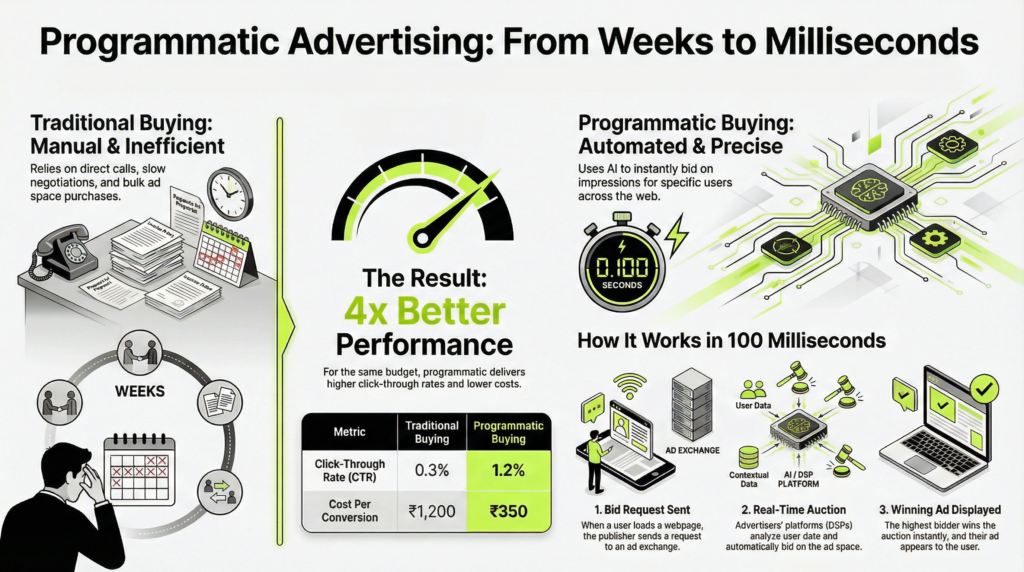
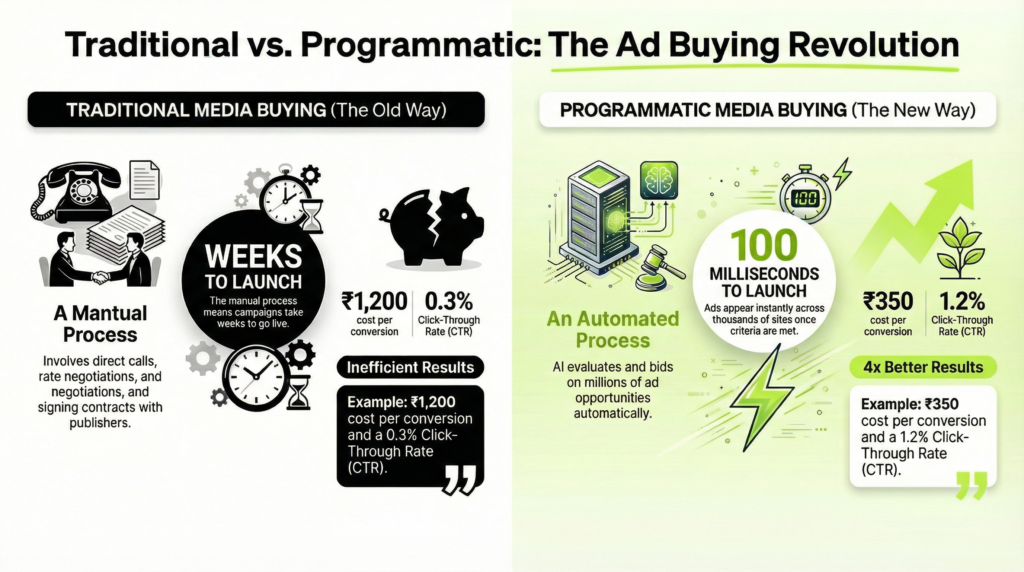
In 2015, buying digital ad space meant calling publishers, negotiating rates, signing contracts, and waiting weeks for campaigns to go live.
In 2026, that same process happens in 100 milliseconds—automatically.
Programmatic media buying is the automated process of purchasing digital advertising using data and technology, rather than manual negotiations.
Here’s the difference:
Traditional Media Buying:
- Contact publishers directly
- Negotiate rates manually
- Sign insertion orders
- Wait weeks for campaign launch
- Limited targeting options
- Reports arrive days after campaign ends
Programmatic Media Buying:
- Set goals and budget in platform
- AI evaluates millions of ad opportunities
- System bids on impressions matching your criteria
- Ads appear instantly across thousands of sites
- Real-time performance data
- Continuous AI optimization
The key insight: Instead of buying ad space in bulk from specific websites, you’re bidding on individual impressions shown to specific users who match your target audience—wherever they browse.
Real Example:
Traditional: Buy 1 million impressions on TimesOfIndia.com for ₹2,00,000. Audience = everyone (mostly not your customers). Result: 0.3% CTR, ₹1,200 cost per conversion.
Programmatic: Target users matching your customer profile across entire web for ₹1,50,000. Result: 1.2% CTR, ₹350 cost per conversion.
Same budget. 4x better results.
How Programmatic Media Buying Actually Works (Behind the Scenes)
When a user loads a webpage, here’s what happens in 100 milliseconds:
Step 1 (5ms): User opens webpage. Publisher’s system recognizes ad slot available.
Step 2 (10ms): Bid request sent to ad exchanges with data: page content, user demographics, device type, location.
Step 3 (50ms): Demand-Side Platforms (DSPs) analyze user against thousands of advertisers’ targeting criteria.
Step 4 (75ms): DSPs calculate bid amounts based on how well user matches target audience, campaign budget, and historical conversion probability.
Step 5 (100ms): Auction runs. Highest bidder wins. Ad displays to user.
This happens billions of times daily across the internet.
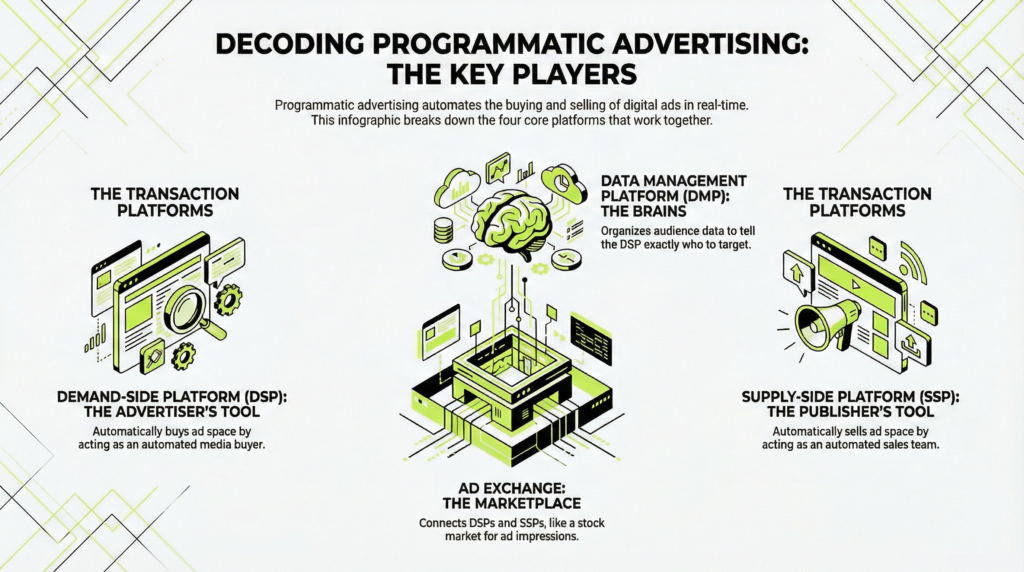
The Programmatic Media Buying Ecosystem: Key Players
1. Demand-Side Platform (DSP)
What it does: Software advertisers use to buy ad inventory automatically.
Think of it as: Your automated media buyer that evaluates billions of opportunities per day and bids on the ones most likely to convert.
Popular DSPs: Google Display & Video 360, The Trade Desk, Amazon DSP
2. Supply-Side Platform (SSP)
What it does: Software publishers use to sell ad inventory automatically.
Think of it as: A publisher’s automated sales team finding the highest-paying advertisers in real-time.
Popular SSPs: Google Ad Manager, Magnite, PubMatic
3. Ad Exchange
What it does: Digital marketplace where DSPs and SSPs meet to buy/sell ad inventory.
Think of it as: The stock market for digital ads—where impressions are traded in milliseconds.
4. Data Management Platform (DMP)
What it does: Collects and organizes audience data, creates segments, sends to DSPs for targeting.
Think of it as: Your customer intelligence system telling the DSP exactly who to target.
Types of Programmatic Media Buying Models
1. Real-Time Bidding (RTB) / Open Auction
- Ad inventory available to any advertiser
- Open auction, highest bidder wins
- Best for: Large audiences, performance campaigns
- Typical CPM: ₹20-150
2. Programmatic Direct
- Negotiate directly with publishers
- Guaranteed impressions at fixed price
- Best for: Brand campaigns, premium placements
- Typical CPM: ₹200-800
3. Private Marketplace (PMP)
- Invite-only auction with select advertisers
- Balance of quality and efficiency
- Best for: Premium inventory at competitive prices
- Typical CPM: ₹100-400
Programmatic Media Buying Targeting Capabilities
The power of programmatic is precision targeting:
1. Demographic Targeting: Age, gender, income, education, job title
2. Geographic Targeting: Country, city, postal code, radius around location
3. Behavioral Targeting: Websites visited, purchase history, search queries, app usage
4. Contextual Targeting: Match ads to page content, keywords, topics
5. Retargeting: Show ads to users who visited your site, viewed products, abandoned carts
6. Lookalike Audiences: Find users similar to your existing customers
7. Device Targeting: Mobile, tablet, desktop, specific OS, browser
8. Time-Based Targeting: Specific days, hours, time zones
9. Frequency Capping: Control how often same user sees your ad
How to Launch a Programmatic Media Buying Campaign (Step-by-Step)
Phase 1: Planning
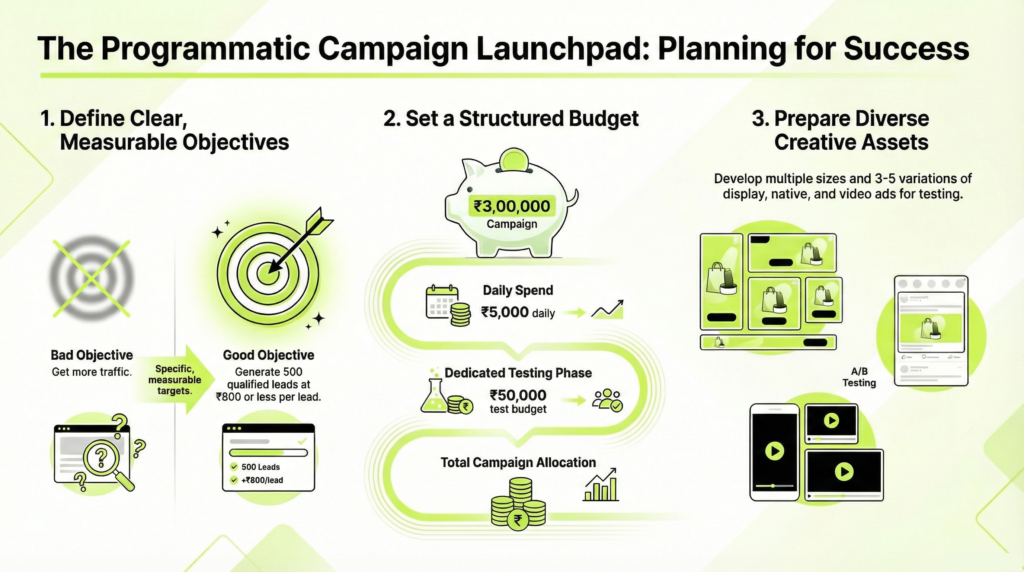
Step 1: Define Clear Objectives
Bad: “Get more traffic”
Good: “Generate 500 qualified leads at ₹800 or less per lead”
Step 2: Set Budget
- Total campaign budget
- Daily pacing
- Test budget (15-20% for learning phase)
Example: ₹3,00,000 total / 60 days / ₹5,000 daily / ₹50,000 testing
Step 3: Prepare Creative Assets
- Display ads: Multiple sizes (300×250, 728×90, 300×600)
- 3-5 variations per size for testing
- Native ads: Headlines, descriptions, images
- Video ads: 15s and 30s versions
Phase 2: Platform Setup
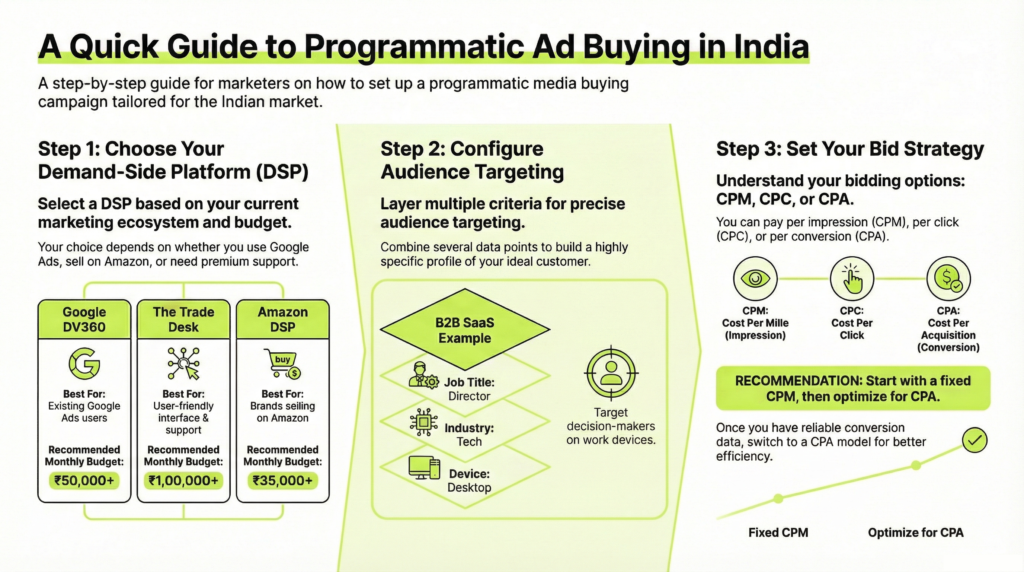
Step 4: Choose Your DSP
For India:
- Google DV360: If you use Google Ads (₹50K+/month recommended)
- The Trade Desk: User-friendly, great support (₹1L+/month)
- Amazon DSP: If selling on Amazon (₹35K+/month)
Step 5: Configure Targeting
Layer multiple criteria:
Example (B2B SaaS):
- Demographics: Age 30-55, Income ₹10L+
- Job Titles: Manager, Director, VP
- Industries: Technology, Finance
- Behaviors: Visited SaaS review sites
- Geography: Metro cities
- Devices: Desktop (B2B happens at work)
Step 6: Set Bid Strategy
Options:
- Fixed CPM: You set exact bid (₹100 CPM)
- CPC bidding: Pay per click (₹15 per click)
- CPA bidding: Pay per conversion (₹800 per lead)
Recommendation: Start with fixed CPM, move to CPA once you have conversion data.
Phase 3: Launch & Optimize
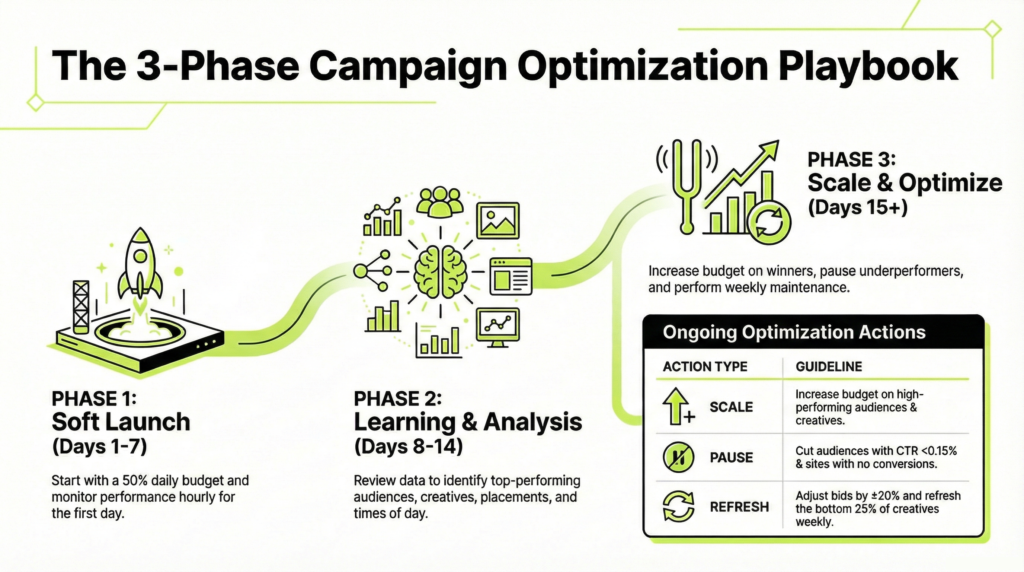
Days 1-7: Soft Launch
- Set daily budget at 50% initially
- Monitor hourly for first 24 hours
- Verify tracking works correctly
Days 8-14: Learning Phase Analysis
Review:
- Which audiences perform best?
- Which creatives get highest CTR?
- Which sites drive conversions?
- What time of day works best?
Days 15+: Optimization
Increase budget on:
- High-performing audiences
- Top-converting creatives
- Best-performing sites
Pause:
- Audiences with CTR <0.15%
- Sites with no conversions after 1,000 impressions
Weekly actions:
- Adjust bids ±20% based on performance
- Refresh bottom 25% of creatives
- Add negative targeting for poor performers
Programmatic Media Buying Costs in India (2026)
Platform Fees
- Google DV360: ~20% of media spend
- The Trade Desk: 15-20%
- Amazon DSP: Variable, often bundled
Media Costs (CPM Benchmarks)
| Inventory Type | CPM Range |
|---|---|
| Open RTB – Display | ₹20-80 |
| Open RTB – Video | ₹100-300 |
| PMP – Display | ₹80-250 |
| PMP – Video | ₹200-500 |
| Programmatic Direct | ₹300-800 |
| Mobile In-App | ₹40-150 |
| Connected TV | ₹200-600 |
Total Cost Example (₹3L Campaign)
Media Spend: ₹2,50,000
Platform Fee (18%): ₹45,000
Creative Production: ₹15,000
Landing Page Optimization: ₹10,000
Total Investment: ₹3,20,000

Expected Results:
- Impressions: 2.5M-5M
- Clicks: 12,500-25,000 (0.5-1% CTR)
- Conversions: 250-625 (2-5% CVR)
- Cost Per Acquisition: ₹512-1,280
Common Programmatic Media Buying Mistakes (And How to Avoid Them)
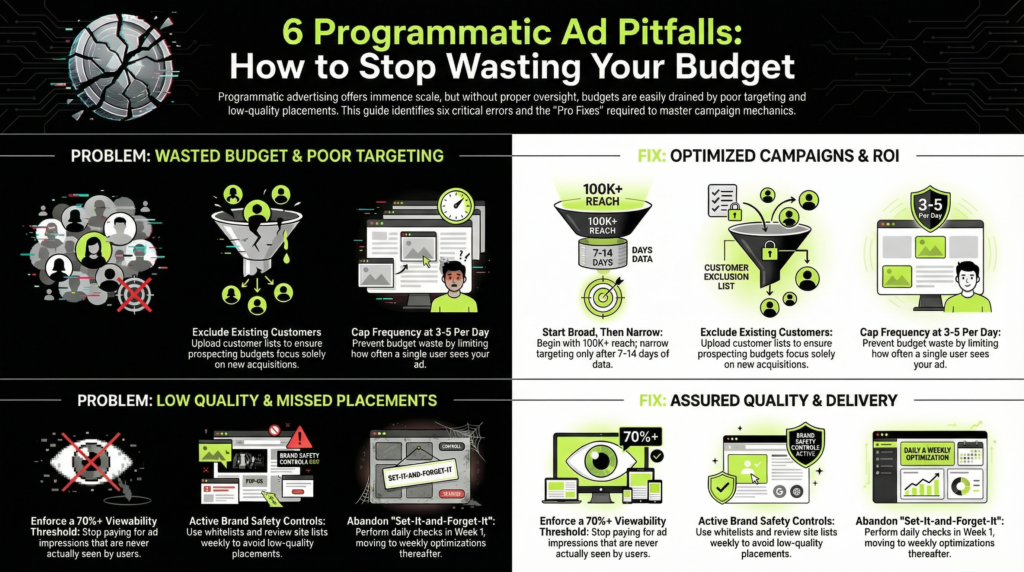
Mistake #1: No Brand Safety Controls
Problem: Ads appear on low-quality or inappropriate sites
Fix: Use whitelists, enable brand safety settings, review site lists weekly
Mistake #2: Too Narrow Targeting Initially
Problem: Audience too small, no data to optimize
Fix: Start broad (100K+ reach), narrow after 7-14 days based on performance
Mistake #3: Not Excluding Existing Customers
Problem: Wasting budget on people who already bought
Fix: Upload customer list, create exclusion audience for prospecting campaigns
Mistake #4: Ignoring Viewability
Problem: Paying for impressions users never see
Fix: Set 70%+ viewability threshold, exclude low-viewability placements
Mistake #5: Set-It-and-Forget-It
Problem: Performance degrades over time
Fix: Week 1 daily checks, weeks 2-4 every 2-3 days, monthly weekly optimization
Mistake #6: No Frequency Cap
Problem: Same user sees ad 50+ times, wasting budget
Fix: Set cap at 3-5 impressions per user per day
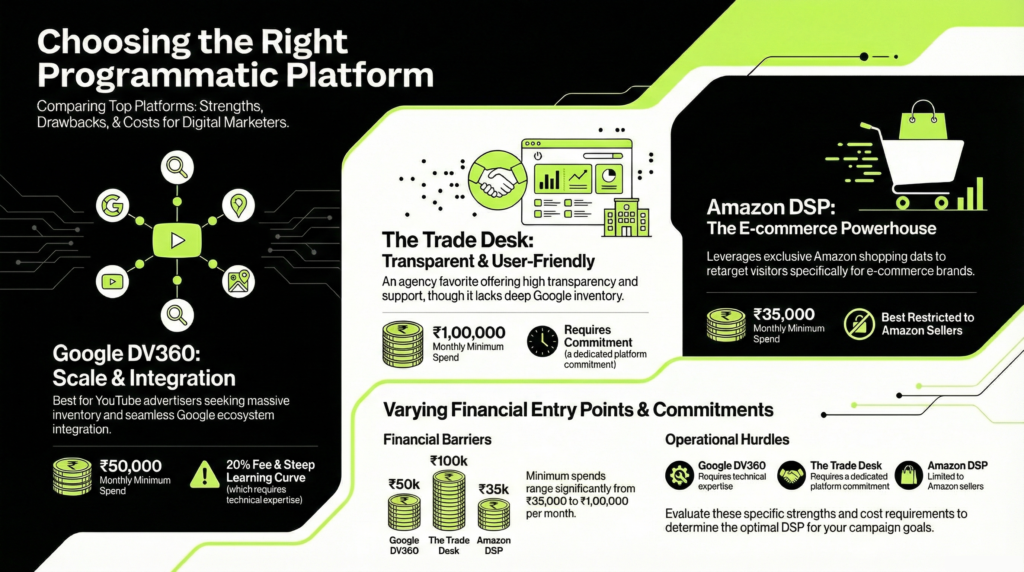
Which Programmatic Media Buying Platform Should You Use?
Google Display & Video 360 (DV360)
Best for: Businesses using Google Ads, YouTube advertisers
Pros: Massive inventory, Google integration, excellent reporting
Cons: 20% fee, steep learning curve
Minimum: ₹50,000/month
The Trade Desk
Best for: Agencies, performance marketers
Pros: User-friendly, great support, transparent pricing
Cons: Requires commitment, less Google inventory
Minimum: ₹1,00,000/month
Amazon DSP
Best for: E-commerce sellers, Amazon brands
Pros: Amazon shopping data, retarget Amazon visitors
Cons: Best if selling on Amazon
Minimum: ₹35,000/month
Is Programmatic Right for Your Business?
Programmatic Makes Sense If:
- Minimum ₹25,000/month ad budget
- Need to reach specific audience segments
- Want data-driven optimization
- Running performance campaigns (leads, sales)
- Need scale beyond Google/Facebook
- Have conversion tracking set up
Stick with Google/Facebook Ads If:
- Budget under ₹25,000/month
- No conversion tracking capability
- Need guaranteed premium placements only
- Just starting with digital advertising
Your Programmatic Action Plan
Programmatic isn’t the future—it’s the present. 88% of digital display advertising is already programmatic.
Your Next Steps:
If you’re new:
- Start with ₹50K-1L test budget
- Choose Google DV360 or The Trade Desk
- Begin with retargeting (easier to show ROI)
- Run 60 days minimum before judging
- Learn, optimize, scale
If you’re already running programmatic:
- Audit against mistakes in this guide
- Test new targeting layer this month
- Implement brand safety controls
- Review and refresh creatives
- Verify conversion tracking accuracy
Need Help with Programmatic Advertising?
Bit Binders offers programmatic advertising strategy and management for businesses looking to scale beyond Google and Facebook.
We handle:
- Platform selection and setup
- Audience strategy and targeting configuration
- Creative production and A/B testing
- Campaign management and continuous optimization
- Transparent reporting (you see everything)
- Monthly strategy sessions
Our approach:
- Start with thorough audience analysis
- Set up proper tracking and conversion goals
- Launch with test budget, optimize based on data
- Scale what works, cut what doesn’t
- Monthly reporting with clear ROI metrics
Typical results: 30-60% lower cost per acquisition vs. running campaigns in-house, with higher scale.
Get a free programmatic campaign audit: Contact Bit Binders
Or call +91-8506905999 to discuss your goals.