
ChatGPT advertising is expected to emerge around 2026 as OpenAI moves toward sustainable monetization of one of the world’s most widely used AI platforms. Unlike traditional digital ads, ChatGPT ads will likely appear as context-aware, intent-driven recommendations embedded directly inside conversations—combining search-level intent with behavioral context and fundamentally reshaping how brands capture demand. Based on current signals including key executive hires and beta interface testing, brands that prepare now for AI-native advertising will gain significant competitive advantages in cost, visibility, and market positioning.
The Shift No One in Marketing Can Ignore
Digital advertising has always followed a predictable rule: where sustained human attention exists, monetization eventually follows. Search engines, social networks, marketplaces, and video platforms all evolved the same way—first usage, then scale, then advertising.
Conversational AI is now at that same inflection point.
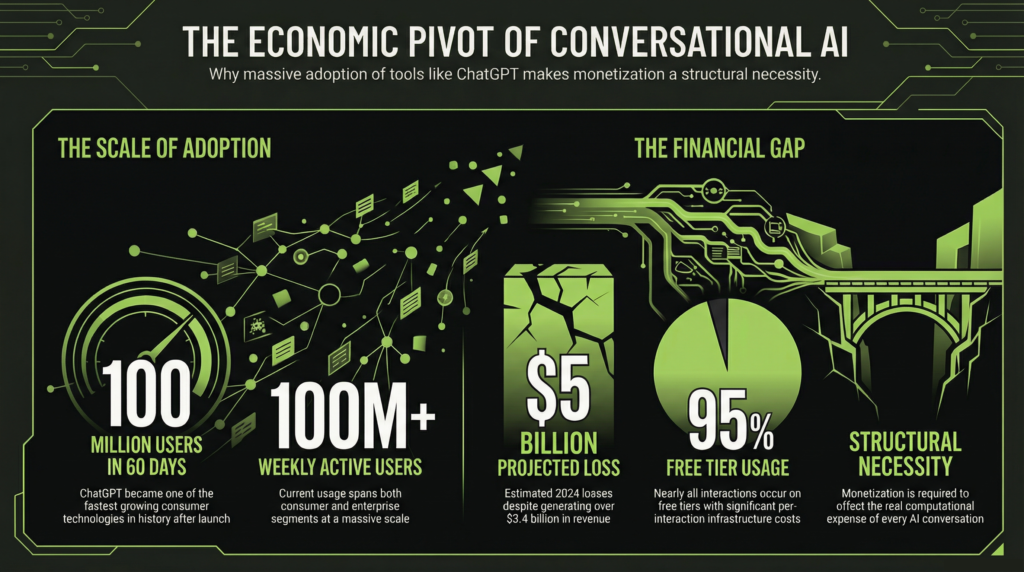
According to Reuters, ChatGPT reached 100 million monthly active users within two months of launch, making it one of the fastest-adopted consumer technologies in history. OpenAI’s DevDay 2023 announcements revealed the platform now serves over 100 million weekly active users across consumer and enterprise segments.
At the same time, The Information reported OpenAI could lose up to $5 billion in 2024 despite generating $3.4 billion in revenue—largely because more than 95% of usage occurs on free tiers with significant infrastructure costs per interaction.
At this scale, every AI conversation carries real computational expense. Monetization isn’t a strategic option anymore—it’s a structural necessity.
What’s Already Happening: The AI Advertising Landscape Today
This isn’t speculation about a distant future. AI advertising is already emerging:
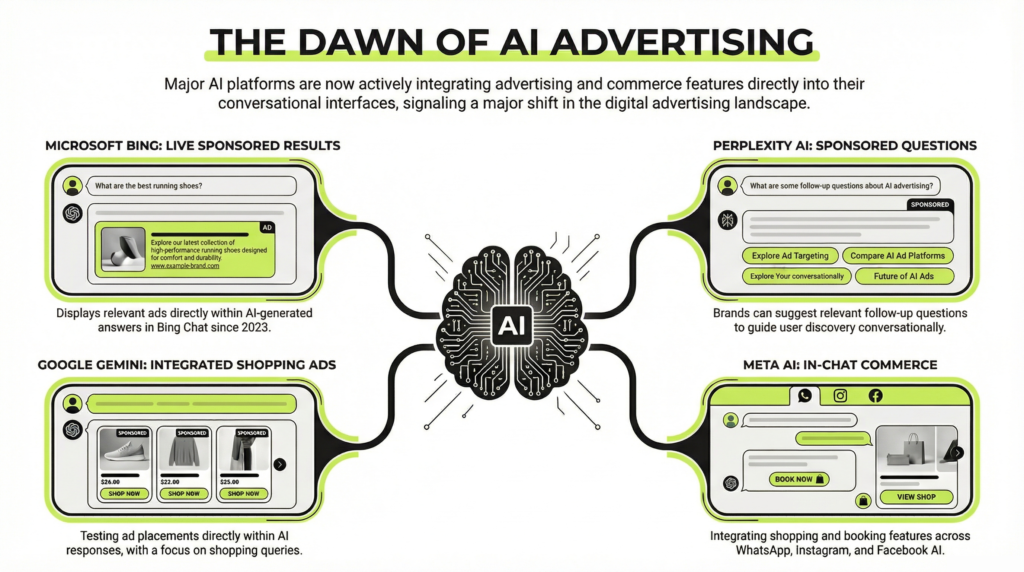
Microsoft Bing Chat Ads (Live Since 2023)
Microsoft integrated sponsored results into Bing Chat responses shortly after launch, displaying relevant ads within AI-generated answers. Advertisers using Microsoft Advertising can already reach users inside conversational search experiences.
Perplexity’s Sponsored Answers (Testing Now)
Perplexity AI announced experiments with “sponsored follow-up questions” where brands can suggest relevant queries users might ask next—a form of conversational advertising that guides discovery without interruption.
Google’s Gemini Integration
Google is testing ad placements within Gemini (formerly Bard) responses, particularly for shopping queries, signaling the search giant’s intention to monetize AI interfaces aggressively.
Meta AI’s Monetization Signals
Meta’s AI assistant, now integrated across WhatsApp, Instagram, and Facebook, shows early signs of commerce integration—allowing users to shop, book, and purchase within conversations.
The pattern is clear: Every major AI platform is moving toward advertising. ChatGPT, with its scale and infrastructure costs, will inevitably join them.
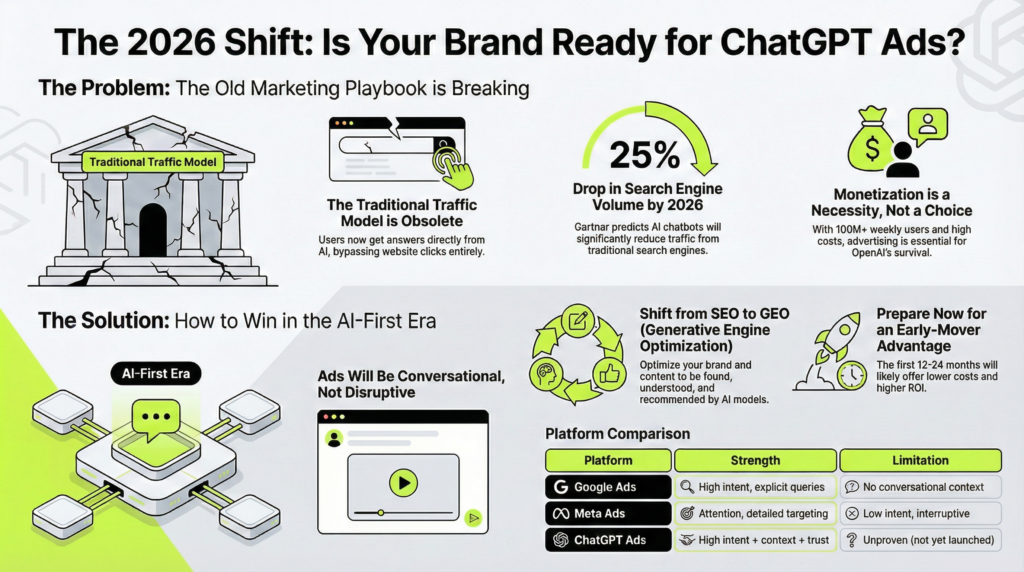
Why the Traditional Traffic Model Is Quietly Breaking
For over two decades, digital growth followed a simple loop:
Create content → rank on search → earn clicks → convert visitors
That loop is now breaking.
Consider a once-profitable “Best CRM Software” blog post. In 2023, it ranked well on Google, earned 10,000 monthly visitors, and influenced purchase decisions. In 2026, that same query is increasingly answered directly inside ChatGPT, Claude, or Gemini. The user receives a summarized comparison, pros and cons, and a recommendation—without clicking a single website.
The brand didn’t lose rankings.
It lost visibility at the moment of decision.
A Gartner prediction estimates traditional search engine volume could drop 25% by 2026 due to AI chatbots and virtual agents. As AI-generated answers replace blue links, organic traffic becomes optional. Paid placement inside AI responses becomes critical for demand capture.
Why ChatGPT Ads Will Look Nothing Like Traditional Ads
ChatGPT ads won’t resemble banner ads or disruptive pop-ups—because interruption breaks trust inside conversational interfaces.
Instead, based on beta testing patterns and Microsoft’s Bing Chat implementation, ChatGPT advertising will likely appear as:
1. Sponsored Recommendations
Surfaced naturally within relevant conversations:
“Based on your needs, here are three project management tools to consider: [Brand A] (sponsored), [Brand B], and [Brand C]. Here’s how they compare…”
2. Partner-Integrated Actions
Booking, purchasing, or scheduling without leaving the chat:
“I can help you book that flight through [Partner Airline]. Would you like to see available options for your dates?”
3. Contextual Placements
Aligned to expressed intent, not inferred demographics:
“For your manufacturing use case, [Software Company] offers an industry-specific solution. Here’s how it addresses your compliance requirements…”
This places ChatGPT in a category of its own:
- Google captures explicit intent (what you’re searching for)
- Meta captures attention (what you’re scrolling through)
- ChatGPT captures intent + context + conversation history, delivered inside a trusted, daily-use interface
No previous platform has unified all three at this scale.
![Why ChatGPT Ads Will Look Nothing Like Traditional AdsChatGPT ads won't resemble banner ads or disruptive pop-ups—because interruption breaks trust inside conversational interfaces.Instead, based on beta testing patterns and Microsoft's Bing Chat implementation, ChatGPT advertising will likely appear as:1. Sponsored RecommendationsSurfaced naturally within relevant conversations:"Based on your needs, here are three project management tools to consider: [Brand A] (sponsored), [Brand B], and [Brand C]. Here's how they compare..."2. Partner-Integrated ActionsBooking, purchasing, or scheduling without leaving the chat:"I can help you book that flight through [Partner Airline]. Would you like to see available options for your dates?"3. Contextual PlacementsAligned to expressed intent, not inferred demographics:"For your manufacturing use case, [Software Company] offers an industry-specific solution. Here's how it addresses your compliance requirements..."This places ChatGPT in a category of its own:Google captures explicit intent (what you're searching for)Meta captures attention (what you're scrolling through)ChatGPT captures intent + context + conversation history, delivered inside a trusted, daily-use interface](https://www.bitbinders.in/wp-content/uploads/2026/01/Why-ChatGPT-Ads-Will-Look-Nothing-Like-Traditional-Ads-1024x572.png)
Why 2026? The Convergence of Critical Factors
Several signals point specifically to 2026 as the inflection year:
1. Key Executive Hire
In May 2024, OpenAI hired Fidji Simo as Chief Product Officer. Simo previously led Meta’s app division and was instrumental in building Facebook’s advertising products that generated hundreds of billions in revenue. You don’t hire a monetization architect of this caliber unless you’re preparing for major commercial rollout.
2. Beta Interface Evidence
TechCrunch reported ChatGPT beta versions have surfaced code references to “search ads,” “promoted results,” and carousel-style placements—infrastructure typically built 12-18 months before public launch.
3. Financial Pressure Timeline
With reported losses of $5 billion annually and infrastructure costs scaling with usage, OpenAI faces pressure from investors to demonstrate sustainable unit economics. Advertising is the fastest path to profitability at this scale.
4. Competitive Pressure
Microsoft, Google, and Perplexity are already monetizing AI interactions. OpenAI cannot cede this revenue stream to competitors indefinitely without risking market position.
5. Technology Maturity
ChatGPT’s conversation quality, context retention, and integration capabilities have reached the threshold where advertising can be valuable rather than disruptive—a critical prerequisite for user acceptance.
The convergence: Executive talent in place (2024), beta infrastructure built (2024-2025), market readiness achieved (2025), financial pressure mounting (ongoing) = Commercial launch window (2026).
The Triple Threat: ChatGPT vs Google vs Meta
ChatGPT advertising combines three forces no single platform has unified before:
| Platform | Strength | Limitation |
|---|---|---|
| Google Ads | High intent, explicit queries | No conversational context, transactional |
| Meta Ads | Attention, detailed targeting | Low intent, interruptive |
| ChatGPT Ads | High intent + context + trust | Unproven (not yet launched) |
Why this matters: ChatGPT knows what you’re trying to accomplish (intent), understands the conversation leading to this moment (context), and operates as a helpful assistant (trust). This combination makes recommendations feel like guidance rather than advertising.
Early placements will be unusually effective—and unusually competitive.
How Forward-Thinking Brands Are Preparing Today
Brands positioned to win in AI-first discovery environments are already adapting:
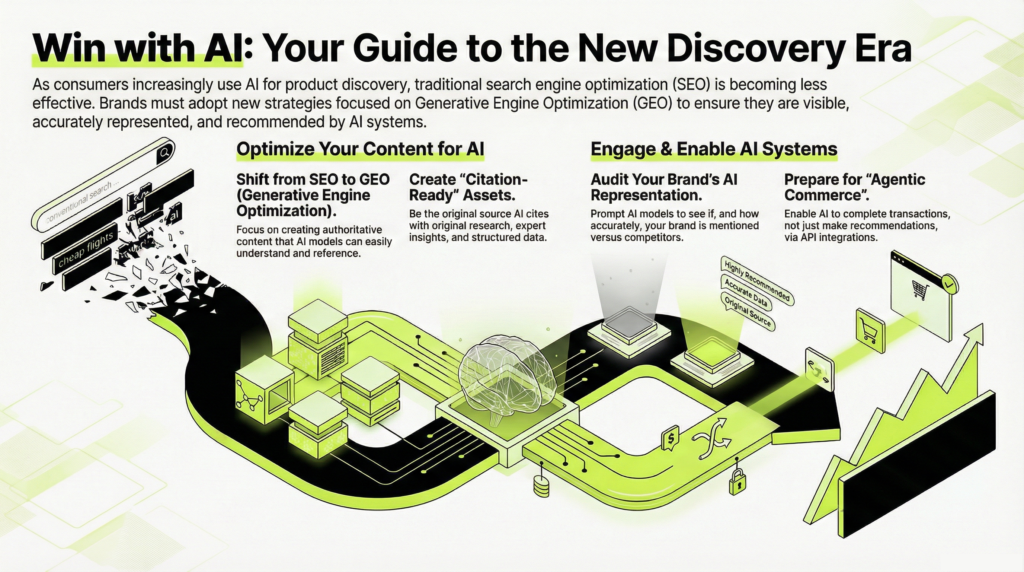
1. Building Generative Engine Optimization (GEO) Strategies
Unlike SEO (optimizing for search engines), GEO focuses on optimizing for AI systems. This means:
- Creating authoritative, citation-worthy content AI models can reference
- Structuring data so AI can extract and understand it easily
- Building brand mentions across trusted sources AI models train on
Example: A SaaS company creates comprehensive comparison guides, publishes original research data, and ensures their product specifications are clearly documented across their site—making it easy for AI to accurately describe and recommend them.
2. Creating Citation-Ready Assets
AI systems cite sources when making recommendations. Being that source matters.
Citation-ready assets include:
- Original research and data (industry surveys, benchmark reports)
- Expert insights and thought leadership (whitepapers, case studies)
- Structured FAQs addressing common buying questions
- Technical documentation and API references
3. Auditing Current AI Brand Representation
Actionable prompt to try today:
“I’m comparing [your product category]. What are the top 3 options, and what are the pros and cons of each?”
Then analyze:
- Are you mentioned?
- Is the description accurate?
- How do you compare to competitors?
- What factors does AI emphasize?
Tools like ChatGPT, Claude, and Perplexity all provide different perspectives. Test across multiple platforms.
4. Preparing Agentic Commerce Pathways
“Agentic commerce” means AI can help complete transactions, not just recommend products.
Examples:
- API integrations allowing AI to check pricing, availability, features
- Booking/purchasing capabilities within conversational interfaces
- Support for AI to access account information (with user permission)
Brands that enable AI to “do” things—not just suggest things—will dominate conversational commerce.
The Early-Mover Advantage in ChatGPT Advertising
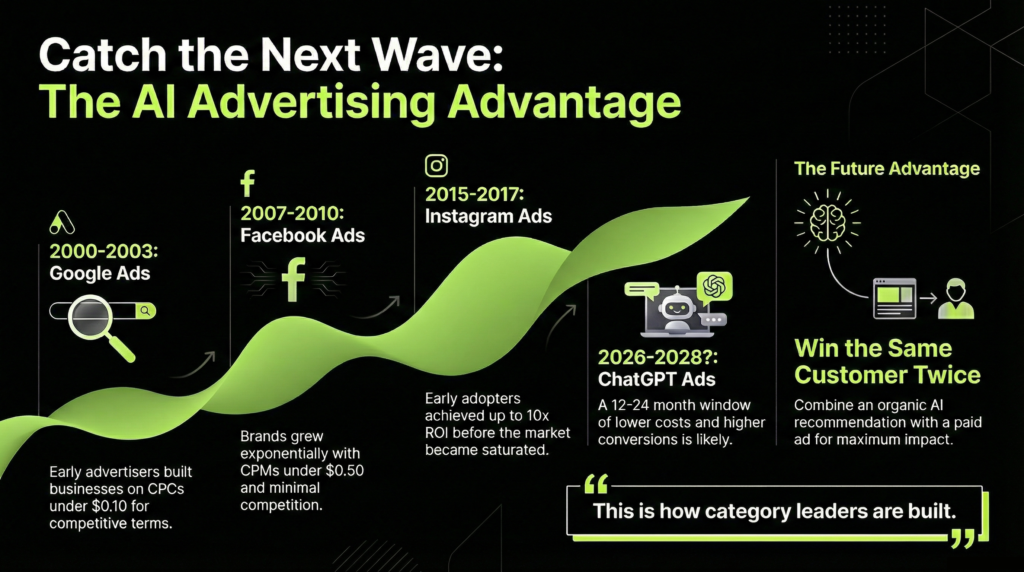
When new ad platforms launch, supply is limited and demand is low.
Historical early-mover advantages:
Google Ads (2000-2003): CPCs under $0.10 for competitive terms. Early advertisers built businesses on cheap, high-intent traffic.
Facebook Ads (2007-2010): CPMs under $0.50, massive reach, minimal competition. Brands grew exponentially on cheap social traffic.
Instagram Ads (2015-2017): Early adopters achieved 10x ROI before saturation drove up costs.
ChatGPT Ads (2026-2028?): Similar window likely exists—12-24 months of lower costs, higher conversion rates, and disproportionate brand authority before market saturation.
Brands that already appear organically inside AI-generated answers gain two opportunities to win the same customer—organic recommendation plus paid reinforcement.
This is how category leaders are built.
What Could Go Wrong? The Realistic Risks
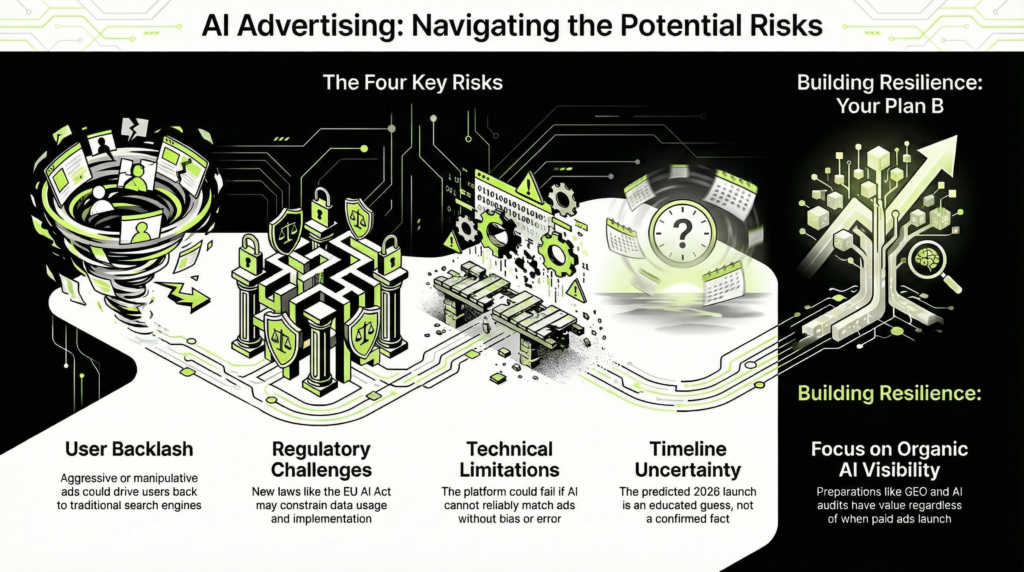
No prediction is certain. Honest analysis requires acknowledging potential failures:
Risk #1: User Backlash
If ads are too aggressive or feel manipulative, users may reject ChatGPT and return to traditional search. OpenAI’s slow, careful rollout suggests they understand this risk.
Risk #2: Regulatory Challenges
AI advertising raises questions about transparency, data usage, and manipulation. EU AI Act regulations and similar policies may constrain implementation.
Risk #3: Technical Limitations
If AI can’t reliably match ads to intent without errors or bias, the platform fails. Quality control at scale remains challenging.
Risk #4: Timeline Uncertainty
2026 is an educated guess based on signals, not confirmed fact. Launch could be 2027, 2028, or phased differently than expected.
Plan B if predictions don’t materialize:
The preparation tactics (GEO, citation-ready content, AI audits) improve discoverability regardless of ad timing. You’re building organic AI visibility—which has value whether or not paid ads launch on schedule.
30-Day Action Plan: Start Preparing Today
Week 1: Audit Current State
- Test how ChatGPT, Claude, Perplexity currently describe your brand
- Document competitors’ AI representation
- Identify gaps and inaccuracies
Week 2: Create Citation-Ready Assets
- Publish one piece of original research or data
- Structure existing content with clear headings and FAQs
- Ensure product specs are clearly documented
Week 3: Build GEO Foundation
- Add structured data markup to your website
- Create authoritative comparison content
- Develop expert thought leadership pieces
Week 4: Monitor and Iterate
- Set up monthly AI brand audits
- Track changes in how AI describes you
- Adjust content based on what AI emphasizes
Final Thought: The Brands That Win Will Adapt Early
AI search is not a future concept—it’s a present behavioral shift.
SimilarWeb data shows ChatGPT receives over 1.6 billion monthly visits, placing it among the top 20 websites globally. Millions of users now default to AI for research, comparison, and decision-making.
Brands that understand conversational discovery early will earn trust, visibility, and demand while others are forced to compete later at higher cost.
Advertising no longer interrupts conversations.
It becomes part of them.
The window to prepare is now. The cost of waiting is higher every month.
Frequently Asked Questions: ChatGPT Ads in 2026
1. Will ChatGPT promote my competitors even if I’m running ads?
Yes, organic AI responses remain independent of paid placements. Ads appear clearly labeled as “Sponsored.” That’s why leading brands focus on Generative Engine Optimization (GEO)—to influence both the organic recommendation and the paid placement, creating a dual-visibility advantage.
2. How do ChatGPT ads differ from Google Search ads?
Google ads target keywords; ChatGPT ads respond to intent within a conversation. Instead of matching search terms, ads are triggered by context, user goals, and follow-up questions—making them more relevant at the decision stage.
3. How is success measured if users don’t click a website?
In AI interfaces, success is measured through Intent Attribution, not clicks. Brands track actions completed inside the chat—such as purchases, bookings, or form submissions—via integrations like Stripe or native partner APIs.
4. Are ChatGPT ads suitable for all industries?
Not immediately. OpenAI restricts ads in sensitive categories such as healthcare diagnoses, politics, or financial manipulation. Most early access focuses on commerce, SaaS, travel, education, and services with clear user intent.
5. Do ChatGPT ads feel intrusive to users?
No—because they don’t interrupt. Ads are presented as contextual recommendations, aligned with the user’s question. Poorly matched ads are filtered out by the system to preserve user trust.
6. Does my brand need special technical preparation for ChatGPT ads?
Yes. Effective participation requires a verified Entity Schema, structured product data, and an optimized OpenAI Merchant or Brand Profile. Without this foundation, ads may underperform or not be approved.
7. What is Generative Engine Optimization (GEO)?
GEO is the process of structuring brand content so AI systems can understand, trust, and recommend it. Unlike SEO, GEO optimizes for how language models synthesize answers—not how humans scroll pages.
8. Can small or mid-size brands compete with large enterprises?
Yes—especially in the early phase. AI ad ecosystems typically launch with low competition and high efficiency, allowing agile brands to outperform larger competitors that move slowly.
9. Do I need to redesign my website for AI ads?
Not entirely—but you may need to add structured data, clearer intent signals, and conversion-ready endpoints so AI systems can connect conversations to actions.
10. Is it ethical to advertise inside a private AI conversation?
OpenAI enforces strict safeguards. Ads only appear for adults, never on sensitive topics, and are clearly labeled. The goal is to remain helpful, not persuasive or manipulative.
11. Will my advertising data be used to train the AI model?
No. OpenAI’s policies separate advertiser data from model training. Campaign data is partitioned, ensuring your competitive insights remain private.
12. Can ChatGPT hallucinate incorrect information about my brand?
Yes, if its training data is outdated or incomplete. That’s why proactive brands conduct AI Sentiment Audits to identify and correct inaccuracies before running ads.
13. Can’t I just manage ChatGPT ads myself like Google or Meta?
Not initially. Early ChatGPT advertising is expected to be invite-only, prioritizing agency partners and pilot brands. Agencies also manage complex Natural Language Ad Creative, which differs fundamentally from static ads.
14. What happens if the AI gives a negative answer about my brand?
Negative sentiment can reduce ad effectiveness. The solution involves AI reputation management—updating source content, improving citations, and correcting public signals the model relies on.
15. Why use an agency instead of AI tools alone?
AI can generate options quickly—but human judgment decides what builds trust. Agencies provide strategic oversight, ethical safeguards, and real-world testing that pure automation can’t replicate.