
What Is Google’s AI Mode and Why Is This Change a Big Deal?
Starting in 2025, Google introduced AI Mode, an evolution of AI-powered search where ads are now placed directly within conversational AI search results — not just classic search pages. This move represents a major shift in how brands reach audiences.
Google highlights that users in markets like the U.S. and India are now seeing a 10%+ increase in searches using AI Overviews, making this format one of the most impactful launches in search engines this decade. blog.google
In this mode, rather than relying on keyword queries, AI Mode enables brands to appear in contextual answers — precisely at the moment people are asking complex questions like “how to build a website for a small business.” The result? A fully conversational flow where brands can interject meaningfully at the perfect moment. blog.google
This model substantially differs from traditional search ads, positioning brands inside narrative-driven results—a huge shift in both mindset and media spend.
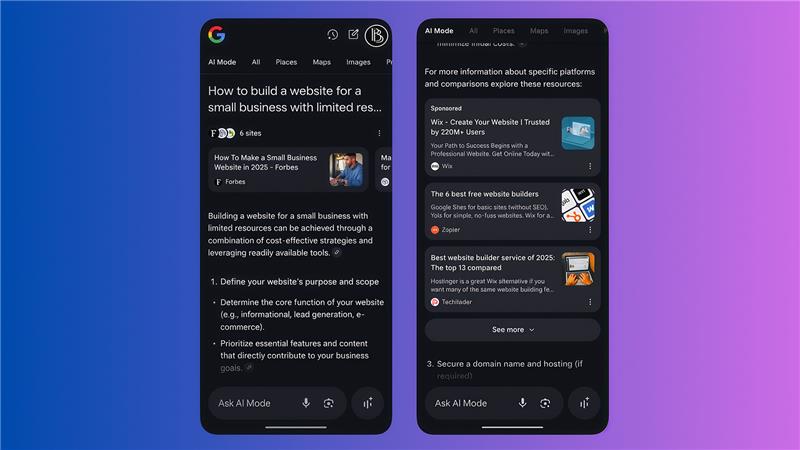
Traditional vs. AI Mode Search Results
In classic search, users see a list of links, ads via search results, and must click through. In AI Mode, users receive a rich answer with bullet points, summaries, and key action steps. Here, ads are seamlessly integrated within the answer flow—not as separate, standalone extensions.
This means conventional ad placement strategies don’t apply: it’s no longer about ranking for page one—the AI assistant places your brand inside the summary.
How Google Ads in AI Mode is Reshaping Ad Targeting & Performance
With the rollout of AI Mode in Google Search and Ads, we are entering a completely new phase of how ads are displayed, targeted, and optimized. This isn’t just a minor update; it’s a complete evolution in the relationship between search intent, content delivery, and ad placement.
How AI Mode Changes Ad Targeting
Traditionally, Google Ads relied heavily on keywords and auction-based targeting. Marketers would bid on specific search phrases, create multiple ad variations, and then rely on Google’s machine learning to improve performance over time.
But AI Mode takes this a step further by:
- Contextual Understanding – Instead of just matching keywords, Google’s AI analyzes the entire meaning behind a search query. This means ads are served based on intent and conversation context, not just exact phrases.
- Real-Time Personalization – AI Mode can adjust ads dynamically in real time based on the user’s browsing history, demographics, search context, and even emotional tone detected in the query.
- Integrated Responses – Ads can now appear within AI-generated overviews rather than in the traditional “sponsored links” area. This means your brand could be part of the AI’s direct answer.
For example, instead of showing a standard ad for “best running shoes,” AI Mode could integrate your brand into an interactive product recommendation inside the AI’s response box.
AI-Powered Ad Formats: The New Ad Experience
One of the biggest changes is the shift from static ad formats to interactive, AI-driven ad experiences. Here’s what’s emerging:
- Conversational Ads – Users can interact with an ad directly through the AI interface, asking follow-up questions and getting responses that link back to your product or service.
- Visual + Text Hybrid Ads – AI Mode allows ads to appear with dynamically generated images, short videos, and product comparisons based on what’s most relevant to the query.
- AI-Suggested Product Carousels – Instead of a regular shopping ad, AI can curate a product list with pros/cons, reviews, and pricing pulled directly from your site.
- Dynamic Call-to-Action (CTA) Placement – Instead of a fixed CTA like “Shop Now,” AI Mode can rewrite the CTA based on user behavior. For example, if the AI senses hesitancy, it might say “See What Other Runners Recommend” instead of pushing for a purchase.
This fluid ad delivery will require brands to prepare multiple content variations and assets so that AI can pick and choose what works best for each unique interaction.
Impact on Ad Performance Metrics
The metrics game is changing too. In the old model, success was tracked via CTR (Click-Through Rate), CPC (Cost Per Click), and conversions. But with AI Mode, marketers will need to watch for:
- Engagement within the AI Experience – Even if a user doesn’t click through immediately, their interaction with your AI-powered ad can be a valuable performance signal.
- Brand Mentions in AI Responses – Your brand may gain visibility within AI summaries, even if it’s not a traditional clickable ad.
- Conversion Lag Time – AI Mode could lengthen the sales funnel since users might explore multiple AI recommendations before making a purchase decision.
- Multi-Touch Attribution Challenges – Tracking exactly where a conversion came from will be trickier, as AI might blend organic recommendations with paid placements.

Challenges Marketers Must Prepare For
While AI Mode brings exciting possibilities, it also creates new challenges for advertisers:
- Loss of Direct Control – You can’t always decide exactly where your ad appears within an AI answer.
- Creative Asset Demands – You’ll need a library of ad creatives for AI to dynamically use based on context.
- Attribution Complexity – Tracking ROI might require advanced analytics tools and Google’s updated conversion APIs.
- Competition for AI Mentions – Just as you fight for keyword rankings now, you’ll soon fight for AI-generated visibility.
Why This Matters for Your 2025 Marketing Strategy
Google’s AI Mode isn’t just a trend—it’s a fundamental shift in the way consumers interact with search and ads. Brands that adapt early will benefit from:
- Being part of the AI-generated answer box that users trust.
- More personalized ad delivery that connects better with user needs.
- Long-term positioning as an authority brand in AI-powered search.
Marketers who ignore this shift risk losing organic and paid visibility to AI-driven recommendations that favor better-optimized, better-prepared brands.
What’s Next for Marketers in the AI-Driven Google Ads Era?
As we step into the second half of 2025, Google’s AI Mode for Ads is no longer a “future trend” — it’s the present reality. Marketers who adapt quickly will gain a competitive edge, while those who cling to outdated strategies risk being overshadowed by AI-powered competitors. But the big question is — where is this technology heading next, and how can marketers prepare for the changes ahead?
1. AI Will Make Search Ads More Conversational
One of the most significant shifts in AI Mode is the move from keyword-triggered ads to conversational ad experiences. Instead of simply matching a keyword to an ad, Google’s AI now understands the user’s intent, mood, and journey stage.
For example:
- A user typing “best sustainable running shoes under ₹5000” may trigger an ad that not only showcases products but also summarizes reviews, compares features, and provides a call-to-action, all in a conversational tone.
- The AI can even adjust the ad language if it detects the user is browsing casually versus urgently looking to purchase.
This means marketers must optimize not just for keywords, but for conversational relevance — providing ad copy and assets that AI can adapt dynamically.
2. Data Privacy and Brand Safety Will Become Bigger Priorities
With AI collecting and interpreting massive amounts of behavioral data, privacy regulations will tighten. Google has already indicated its commitment to a privacy-first advertising approach, but marketers should be proactive.
Steps to prepare:
- Use first-party data as the foundation for targeting.
- Maintain transparent consent policies for customers.
- Ensure your brand guidelines are strong so AI-driven ad placements never misrepresent your tone or values.
3. Creative Testing Will Shift from Manual to AI-Assisted
Traditionally, advertisers would A/B test different versions of creatives over weeks or months. In AI Mode, this is happening in real-time. Google’s AI can instantly analyze performance, swap out underperforming headlines, and adjust creative elements mid-campaign.
What this means for you:
- Focus on providing multiple creative variations for AI to work with.
- Shift your mindset from “set it and forget it” to “feed the AI the best raw materials.”
- Use Google’s creative insights to guide your next content production cycle.
4. SEO and PPC Will Merge Closer Than Ever
Google’s AI Mode blurs the line between organic and paid results. Because AI-generated search responses can integrate ads seamlessly into the answer box, the top organic ranking may no longer guarantee visibility — if a relevant AI ad appears in the same space.
This means:
- Marketers must coordinate SEO and PPC strategies to complement each other.
- Long-tail keywords may become even more valuable in AI-powered ad placements.
- Content should be designed to work both organically and as a paid asset.
5. Ad Metrics Will Evolve Beyond Clicks
AI Mode is bringing new performance indicators that go beyond CTR (Click-Through Rate) and CPC (Cost Per Click). Metrics like “engagement depth,” “brand recall lift,” and “purchase intent increase” are expected to play a bigger role.
Practical steps:
- Start tracking multi-touch attribution to understand how ads influence the customer journey at different points.
- Focus on customer lifetime value (CLV) rather than just immediate conversions.
- Leverage AI-driven insights to adjust not only ads but also landing pages, offers, and overall messaging.
6. Preparing for the AI-First Future
To stay ahead:
- Upskill in AI-driven marketing tools.
- Develop flexible content libraries with adaptable assets.
- Prioritize data hygiene so the AI works with accurate and updated information.
- Stay experiment-friendly — test emerging ad formats like AI-generated video snippets or interactive shopping ads.
Conclusion
Google Ads in AI Mode is not just an upgrade — it’s a paradigm shift in digital marketing. The marketers who will thrive in this new era are those who understand that AI is not replacing strategy, but amplifying it. By embracing conversational ad formats, prioritizing data privacy, leveraging AI-powered creative testing, and aligning SEO with PPC, businesses can not only keep up with the changes but outperform their competition.
The future of Google Ads is here — and it’s powered by intelligence, personalization, and adaptability. The question is: are you ready to let AI be your co-pilot in marketing success?
Faq’s
1. What is Google Ads AI Mode in 2025?
Google Ads AI Mode in 2025 is the latest evolution of automated ad management powered by advanced machine learning algorithms. It uses Google’s AI to analyze billions of data points in real-time, optimizing targeting, bidding, and creative selection without constant manual adjustments. The system dynamically adapts to audience behavior, seasonal trends, device preferences, and even search intent.
Compared to older automation models, AI Mode in 2025 integrates deeper with Google’s predictive analytics, meaning campaigns can self-adjust to achieve maximum results at the lowest cost possible. For advertisers, it means less guesswork and more measurable returns.
2. How does AI Mode improve ad targeting and conversions?
AI Mode enhances targeting by leveraging audience signals far beyond basic demographics. It evaluates user intent, search patterns, past interactions, and even engagement with similar brands to display ads at the perfect time and place.
When it comes to conversions, AI Mode uses predictive modeling to show your ads only to people most likely to take action—whether that’s a purchase, form fill, or inquiry. It constantly tests ad variations and allocates budget to the highest-performing combinations, resulting in higher click-through rates and conversion rates compared to manual campaigns.
3. What are the main benefits of using AI Mode in Google Ads?
The key benefits include:
Advanced Targeting – Reaches audiences with precision based on intent and behavior.
Automated Bidding – Adjusts bids in real-time to get the most value per click.
Creative Optimization – Rotates and tests ad creatives to find the best performers.
Faster Scaling – Quickly identifies winning campaigns and scales them.
Reduced Waste – Minimizes spend on low-quality traffic.
For businesses, this means better ROI, more leads, and less time spent on manual campaign management.
4. Are AI Mode ads more expensive than regular Google Ads?
AI Mode ads aren’t inherently more expensive; in fact, they often provide a lower cost per acquisition (CPA) because they focus spend on high-intent clicks. While the initial cost per click (CPC) might be slightly higher in competitive industries, the overall return on ad spend (ROAS) is usually better.
Think of it this way: instead of paying for 100 clicks with 5 conversions, you might pay for 70 clicks with 10 conversions—meaning more results for the same or less budget.
5. Why is Bit Binder the best choice for managing AI Mode ads?
Bit Binder combines cutting-edge Google Ads AI Mode technology with human expertise. While AI handles the heavy lifting, our ad specialists provide strategic oversight to ensure campaigns align with your business goals. We:
Set up AI Mode campaigns for maximum efficiency from day one.
Continuously monitor AI decisions to avoid misallocation of budget.
Use proprietary tracking tools to measure ROI beyond Google’s default metrics.
Customize targeting for your niche and location.
The result is a blend of AI precision and human strategy that delivers exceptional outcomes.
6. Can AI Mode help reduce wasted ad spend?
Yes. One of the strongest features of AI Mode is its ability to detect and cut off low-quality clicks almost instantly. By monitoring engagement patterns, bounce rates, and conversion behavior, the AI reallocates your budget to the highest-performing segments. Over time, this leads to a dramatic reduction in wasted ad spend and higher profitability.
7. How does Bit Binder improve the performance of AI Mode Google Ads campaigns in Delhi?
For Delhi-based businesses, Bit Binder applies hyper-local targeting strategies that the AI enhances with real-time bidding. We analyze local search trends, competitor activities, and seasonal demand shifts unique to Delhi.
This means AI Mode doesn’t just target “people in Delhi” but zeroes in on the exact neighborhoods, audiences, and timings where your conversions are most likely to happen—whether you’re a service provider in Connaught Place or an e-commerce seller shipping across NCR.
8. Does Bit Binder provide real-time optimization for AI Mode ads?
Absolutely. While AI Mode inherently updates in real-time, Bit Binder adds manual real-time checks to ensure the AI’s adjustments are aligned with your goals. We monitor performance dashboards throughout the day, making instant adjustments to creatives, budgets, or targeting if we spot an opportunity or risk. This human-AI synergy ensures your campaigns never plateau.
9. Why is Bit Binder the best choice for managing AI Mode ads in India?
In the Indian market, consumer behavior can vary drastically between regions, languages, and buying patterns. Bit Binder understands these nuances and configures AI Mode to cater to each specific audience segment.
Our India-focused approach ensures:
Region-specific targeting
Culturally relevant ad creatives
Budget allocation based on local cost efficiency
We’ve helped businesses across India—from startups to large enterprises—scale their advertising with AI Mode, making us a trusted partner for high-performance campaigns.