

One careless remark. One viral meme. Millions of frustrated young Indians. Here’s how the
Cockroach Janta Party took over the internet — and why it matters.
The Comment That Started It All
On May 15, 2026, India’s Chief Justice Surya Kant was hearing a case about people entering the
legal profession using fake degrees. What happened next, nobody expected.
During the hearing, the Chief Justice compared unemployed young people to “cockroaches“
and “parasites” — people who, in his words, attack the system through media, social media, and
RTI activism.
He later clarified that the remark was aimed only at fraudsters using fake credentials, not at
unemployed youth in general.
But by then, it was too late.
Clips. Quotes. Screenshots. They spread like wildfire.
And for millions of young Indians already struggling with unemployment, exam scandals, and a
system that feels deaf to their problems — those words hit differently.
Why This Hit So Hard
To understand why this comment exploded, you need to understand the mood of young India
right now.
India’s unemployment crisis among educated graduates is at a breaking point. Millions of young
people spend years studying, clearing competitive exams, and working toward a stable future —
only to find that the jobs simply aren’t there.
And the exam system that was supposed to be their way out? That’s broken too.
The NEET paper leak controversy shook public trust in medical entrance exams to its core.
Students who had sacrificed years of their lives to prepare felt cheated, betrayed, and furious. But
NEET was not alone. Reports of irregularities around CBSE exams added even more fuel to an
already raging fire. Young people across the country — from small towns to big cities — began
asking the same question: Is any exam in this country actually fair?
This is the India that Chief Justice Surya Kant’s comment landed in. A generation already
exhausted, already angry, already feeling like the system had failed them at every step.
So when a sitting Chief Justice compared struggling young people to cockroaches, it did not feel
like a misspoken legal analogy.
It felt like a slap.
How a Meme Turned Into a Movement
The spark that lit the fire came from Abhijeet Dipke, a digital strategist from Maharashtra.
On X (formerly Twitter), he posted:
“Launching a new platform for all the cockroaches out there.“
He attached a Google Form. People could sign up.
It was satire. Obviously. But within hours, thousands had joined. And within days, the joke had
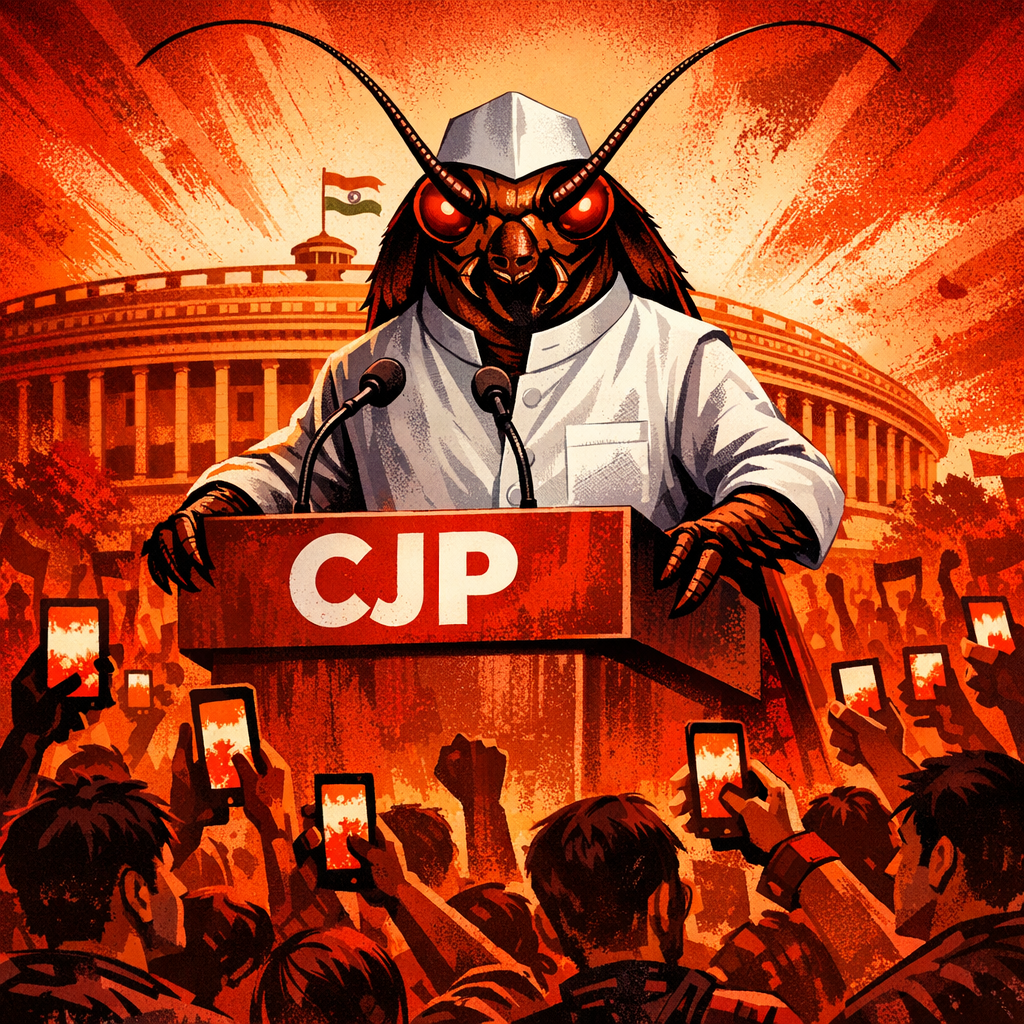
evolved into something much bigger — the Cockroach Janta Party (CJP).
Dipke, who had previously worked on political social media campaigns, knew exactly what he
was doing. He built CJP as a meme-first movement designed for India’s chronically online
generation.
Everything about it was dripping with sarcasm. And the slogan said it all:
“Secular, Socialist, Democratic, Lazy“
A four-word gut punch aimed directly at every politician who has ever promised jobs and
delivered nothing. Beyond the slogan, the rest of the party’s identity was just as sharp:
- Headquarters: Wherever the Wi-Fi works
- Election Symbol: A mobile phone
- Target Audience: Unemployed, frustrated, internet-addicted Indian youth
People laughed. And then they thought: Wait, this is actually how I feel.
Why CJP Spread So Fast
Traditional political parties speak in rallies, TV debates, and press conferences.
CJP spoke in memes.
That is the key to understanding why it exploded so quickly. Gen Z and millennials in India did
not just find CJP funny — they found it relatable. For the first time, a political statement was
speaking their language, in the spaces they actually live in.
Instead of pretending to be powerful and polished, CJP owned the reality of being:
- Unemployed
- Underpaid
- Chronically online
- Politically invisible
That honesty was rare. And it resonated.
CJP felt less like a political party and more like a massive group chat where everyone finally admitted the same thing out loud.
Behind the Jokes Were Real Demands
Make no mistake — this was not just internet humour. CJP released a five-point manifesto, each
demand targeting a real, documented failure of the system.
- Judicial Independence — No retired Chief Justice shall receive a Rajya Sabha seat. FormerCJI Ranjan Gogoi accepted one just 16 weeks after retiring. Former CJI P. Sathasivam becameGovernor of Kerala. CJP wants this practice banned permanently.
- Electoral Accountability — If any legitimate vote is deleted in any state, the Chief ElectionCommissioner is personally accountable. No exceptions.
- Examination Fraud — Full inquiry into the NEET paper leak, resignation of the Education Minister, and scrapping of CBSE’s answer sheet rechecking fee. The manifesto stands with “every student who has been a victim of exam frauds like NEET and CBSE.” The party even released a protest song — Haan Main Hoon Cockroach — directly referencing student rage against the broken exam system.
- Public Finance and Crony Capitalism — Full public accounting of government spending. Cancellation of broadcasting licenses for Adani and Reliance-owned media. No anonymous donations. No electoral bonds. As Prashant Bhushan, who publicly backed CJP, said: India’s “economy and society are bleeding for the benefit of crony capitalists.”
- Youth Representation — Not a youth wing, not a token gesture. Structural inclusion of youngIndians in formal political processes, built into the system by design.
The memes got people through the door. The manifesto made them stay.
The Numbers Behind the Anger
The CJP’s membership criteria require applicants to be “unemployed — by force, by choice, or by
principle.” That line is a joke. But the reality behind it is not.
India’s graduate unemployment rate stands at 29.1 percent — nine times higher than the
unemployment rate for people who never attended school. The country produces more than 8
million graduates every year, but the economy has not come close to generating enough jobs to
absorb them.
These are not lazy people. These are not parasites. These are young Indians who did everything
right — and then found that the system had no place for them.
Ashish Joshi, a retired Indian bureaucrat who joined the CJP, told Al Jazeera: “In the last decade,
there has been a lot of fear in the country. And people are scared to speak. India has become so
hateful that the Cockroach Janta Party is like a breath of fresh air.”
That one quote says more about why CJP exploded than any trend report could.
How the Internet Made It Go Nationwide
CJP was engineered for virality from the beginning.
Parody campaign posters. Short video clips. Sarcastic slogans. WhatsApp forwards. Instagram
reels. Trending hashtags.
Within days:
- Tens of thousands had officially “joined” the movement
- Hashtags related to CJP were trending nationally
- Millions of users across India were talking about it online
Even people who normally avoid political conversations got pulled in — because the content was
funny, shareable, and surprisingly honest.
The internet did what no election campaign could have done in five days.
The Power of Reclaiming an Insult
Perhaps the most powerful thing CJP did was turn the insult around.
Instead of being hurt by the “cockroach” label, the movement embraced it:
“If the system sees us as cockroaches — then fine. We are the cockroaches. And we are
everywhere.“
That kind of emotional reversal — owning the insult rather than defending against it — gave the
movement an identity that was impossible to ignore or dismiss.
It is not a new tactic. But it worked perfectly here, because the anger underneath it was already
real.
Is CJP an Actual Political Party?
Right now, no.
CJP is primarily a satirical online movement. It has no candidates, no formal registration, and
may never contest an election. It could fade away in a few weeks.
But whether or not CJP survives, its impact is already visible. It forced a conversation — about
unemployment, about institutional respect for young people, about how India’s courts and
government communicate with the next generation.
And it proved something very important: memes are no longer just entertainment. They are a
form of protest.
What CJP Really Tells Us About India in 2026
Not everyone is convinced. Some critics have called CJP “mere meme politics” — a flash of
internet anger that will fade as quickly as it appeared. And that is a fair concern.
But others see something more significant. YouTuber Meghnad S put it perfectly: “Cockroach
Janta Party is a satirical, non-existent party, yet people believe that it is a better alternative to
reality. That’s kind of a giant commentary on Indian political parties in general.“
Think about that for a moment. A joke party. No candidates. No offices. No election funding. And
millions of people find it more credible than the parties that actually run this country.
CJP went viral in five days because every single ingredient was already in place — a generation
under enormous pressure, feeling unseen and mocked by the very institutions built to serve
them. A comment that crystallised all of that frustration into a single, stinging word. And
someone smart enough to channel that anger into something funny, shareable, and impossible to
look away from.
Whether CJP becomes a lasting force or just a moment in internet history, its message is already
loud and clear:
Young India is frustrated. Young India is watching. And young India has found its own voice —
even if that voice currently sounds like a meme.
What do you think about CJP and what it represents? Share your thoughts in the comments
below