
“We need to do digital marketing” and “We need performance marketing” often get used in the same breath — in board meetings, founder conversations, and marketing agency pitches alike. But they’re not interchangeable, and confusing the two can quietly derail a brand’s growth strategy.
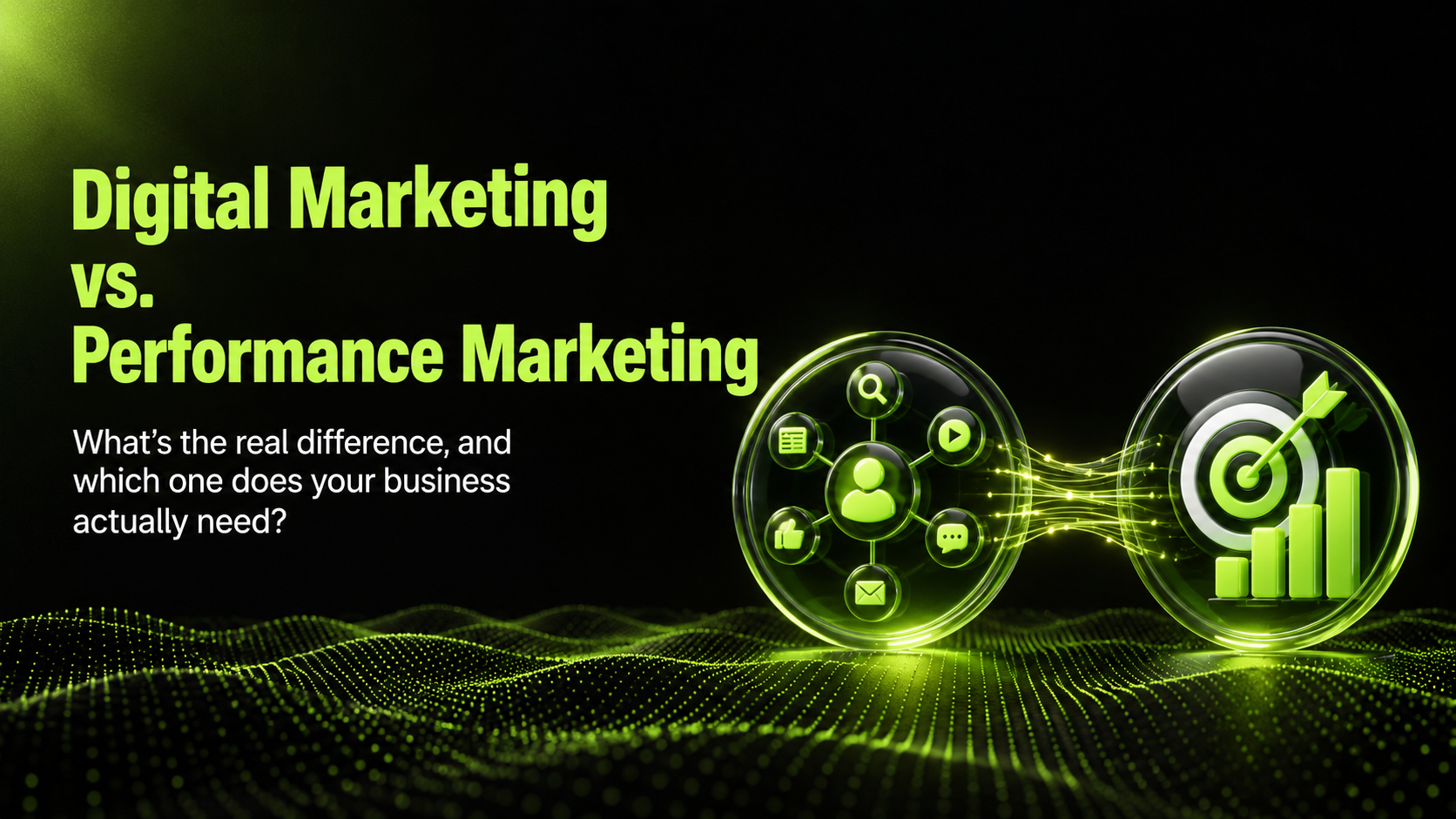
One is the ocean. The other is a specific current inside it.
If you’ve ever wondered why your “digital marketing” spend isn’t translating into direct sales — or why a “performance marketing” campaign is generating leads but doing nothing for your brand’s long-term recall — this post is for you. Let’s break down exactly what separates the two, and how to know which one your business needs right now.
What Is Digital Marketing?
Digital marketing is the umbrella term for every marketing activity that happens through digital channels — websites, search engines, social media, email, apps, and more. It covers both brand-building and direct-response efforts, and it plays the long game as much as the short one.
What Falls Under Digital Marketing
Digital marketing includes activities like:
- Search Engine Optimization (SEO)
- Social media marketing and content strategy
- Email marketing and newsletters
- Content marketing (blogs, videos, podcasts)
- Website design and user experience
- Online reputation management (ORM)
- Brand awareness campaigns across digital platforms
The Core Goal of Digital Marketing
The primary aim is building a brand’s overall digital presence — visibility, trust, engagement, and long-term relationships with an audience. Not every piece of content or campaign is designed to sell something immediately. A lot of it is designed to be remembered, trusted, and returned to later.
What Is Performance Marketing?
Performance marketing is a specific subset of digital marketing, laser-focused on one thing: measurable, trackable results tied directly to spend. Every rupee spent is expected to be accountable for a specific outcome — a click, a lead, a sale, a download.
What Falls Under Performance Marketing
Performance marketing includes activities like:
- Pay-Per-Click (PPC) advertising, including Google Ads
- Social media ads (Meta Ads, LinkedIn Ads, Instagram Ads)
- Affiliate marketing
- Programmatic advertising
- Retargeting and remarketing campaigns
- Conversion Rate Optimization (CRO)
The Core Goal of Performance Marketing
The primary aim is driving specific, measurable actions — and paying based on that performance. If a campaign isn’t converting, it gets paused, tweaked, or killed almost immediately. There’s no room for “brand building” as an excuse; the numbers have to justify the spend, every single time.
Digital Marketing vs. Performance Marketing: The Key Differences
1. Scope and Definition
Digital marketing is the broad category — the entire toolkit of online marketing activities a brand can use. Performance marketing is one specific tool inside that toolkit, focused purely on paid, trackable, results-driven campaigns.
Why This Distinction Matters
Every performance marketing campaign is technically digital marketing, but not every digital marketing activity is performance marketing. An SEO blog post that takes six months to rank isn’t performance marketing — but it’s absolutely digital marketing.
2. Timeframe: Long Game vs. Short Game
Digital marketing often plays out over months and years. SEO, brand content, and community building compound slowly, but the results tend to be durable and self-sustaining once momentum builds.
Performance marketing operates on a much shorter clock. Campaigns are built to show results within days or weeks, and the moment the ad spend stops, the traffic and leads generally stop too.
The Trade-Off to Understand
Digital marketing builds an asset that keeps working even when you’re not actively spending on it. Performance marketing generates fast results, but it’s largely rented attention — pause the budget, and the pipeline dries up almost immediately.

3. Measurement: Brand Metrics vs. Hard Numbers
Digital marketing is often measured using softer, brand-oriented metrics — website traffic, engagement rate, brand mentions, time on page, social following growth, and share of voice.
Performance marketing is measured almost exclusively through hard, bottom-line numbers — Cost Per Click (CPC), Cost Per Lead (CPL), Return on Ad Spend (ROAS), conversion rate, and Customer Acquisition Cost (CAC).
What This Means for Reporting
If your marketing team’s monthly report leans heavily on “impressions” and “engagement,” you’re likely looking at digital marketing efforts. If it leans on “leads generated” and “cost per conversion,” that’s performance marketing at work.
4. Budget Behavior
Digital marketing budgets are often treated as an ongoing investment — content doesn’t stop just because last month’s blog post didn’t go viral. The value compounds over time, so the spend is somewhat decoupled from immediate, individual results.
Performance marketing budgets are treated as a direct lever — spend is scaled up the moment a campaign performs well, and cut immediately the moment it underperforms.
The Practical Impact
A performance marketing budget can (and should) shift week to week based on real-time data. A digital marketing budget tends to stay steadier, because its value is realized in aggregate, over a longer horizon.
5. Risk Profile
Digital marketing carries a slower-burning risk: the risk of investing time and resources into brand-building activities that may take months to show tangible ROI, with no absolute guarantee of when — or how strongly — that ROI arrives.
Performance marketing carries a faster, sharper risk: budget can be spent quickly and, if targeting or messaging is off, can be lost with very little to show for it in a matter of days.
Why Businesses Often Use Both
This is precisely why most mature marketing strategies don’t choose one over the other — they use performance marketing to generate near-term revenue and cash flow, while digital marketing builds the brand equity that makes performance campaigns cheaper and more effective over time.
So, Which One Does Your Business Actually Need?
If You’re a New Business with Limited Runway
You likely need performance marketing first. You need revenue in the door, and you need it measurably tied to spend so you know exactly what’s working. A well-managed PPC campaign can generate leads or sales within days of launch, giving you the breathing room to invest in longer-term brand building later.
If You’re an Established Brand Looking to Scale Sustainably
You likely need a stronger digital marketing foundation — particularly SEO and content strategy — so you’re not permanently dependent on ad spend to stay visible. Brands that rely solely on performance marketing often find that the moment they pause spending, their visibility disappears with it.

If You Want the Best of Both Worlds
Most businesses that grow sustainably don’t pick a side — they build an integrated strategy where performance marketing drives immediate revenue while digital marketing compounds brand trust and organic visibility in the background. If you’re unsure where your business currently stands or where to start, a proper growth strategy consultation can help map out the right mix for your specific stage and budget.
Digital marketing and performance marketing aren’t competing strategies — they’re complementary ones operating on different timelines with different goals. Performance marketing answers the question “how do we get results right now?” Digital marketing answers the question “how do we build something that keeps generating results without constant spend?”
The businesses that grow fastest and most sustainably are rarely the ones that pick one over the other. They’re the ones that know exactly when to lean on each — and build a strategy where both are working together, not against each other.
Not sure whether your business needs performance marketing, digital marketing, or a combination of both? Get in touch with Bit Binders — we’ll help you figure out the right growth strategy for where you are right now.